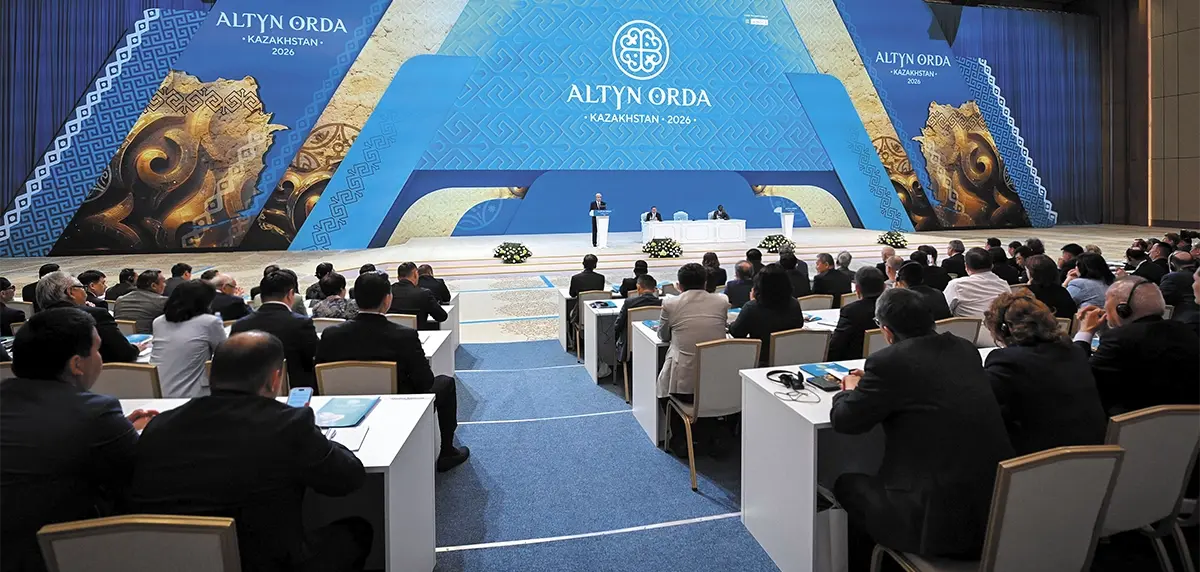
Kazakhstan’s President Kassym-Jomart Tokayev has called on his country to look to the Golden Horde as a model.
A yearning to return to origins, find one’s roots, and take fierce pride in them has seized peoples the world over. The founder of the Mongol Empire, Genghis Khan, has for some reason been becoming particularly popular of late. In the Russian republic of Tuva (Tyva), for instance, the Supreme Khural has instituted a new state honour — the Order of Subutai (Subedey — the brilliant Mongol general, 1175−1248, born in the territory of present-day Tuva, who under the political direction of Genghis Khan’s grandson Batu effectively conquered Kievan Rus, becoming notorious for extraordinary brutality; see the medieval Russian chronicle The Tale of the Ruin of Ryazan).
Kazakhstan, as an independent state, has decided to return to the origins of the entire Golden Horde. President Kassym-Jomart Tokayev, on 19 May 2026, called for a positive reassessment of Golden Horde history.
"The territory of the Ulus of Jochi (the Ulus of Jochi — the formal name of the Golden Horde, the western khanate of the Mongol Empire, founded by Batu Khan circa 1240 and named after Genghis Khan’s eldest son Jochi) at its height exceeded 6 million square kilometres — considerably larger, incidentally, than the Roman Empire at its maximum extent. It is not for nothing that some historians call the Golden Horde the Steppe Rome. Yet the greatness of the Golden Horde was measured not by geographical reach but by institutional resilience. The Jochids ruled the states of the Great Steppe for over 600 years — comparable, for example, to the duration of dynasties such as the Han or the Habsburgs," — he declared at the symposium 'The Golden Horde as a Model of Steppe Civilisation'.
This statement exploded like a media bomb, though it was not entirely unexpected. President Tokayev, when reflecting on the formation of Kazakhstani statehood, far too often speaks of 'wise khan-biys' (khan-biy — the title combining khan, ruler, and biy, a traditional Kazakh judicial and political authority figure) roaming the boundless steppes, but practically never mentions the Russian imperial or Soviet periods.
In May the National Bank of Kazakhstan issued a coin dedicated to the Golden Horde (925 sterling silver with gilding). Funded by Kazakhstan’s Ministry of Culture and Information, a film has been released — Zhoshy Khan: Lord of the Great Ulus — about the Mongol khan Jochi. It seems to be about the events of the thirteenth century; what could possibly be Russophobic about that? But the film’s producer and screenwriter, M. Bekbayeva, explained her intentions to anyone who had not understood them in an interview. According to this young, attractive, and European-polished woman who speaks impeccable Russian, Soviet historical scholarship deliberately humiliated Kazakhs by distorting the truth about the Golden Horde to suit Great Russian chauvinism.
"Ideological inquisition — that is what Soviet ideologists did to the history of Kazakhstan. And the most important pages of our past were burned on that pyre," — she declared. So the President merely joined a long-established movement in order to lead it.
Well, let us return to the Golden Horde that the President has grown so fond of. Let us go through point by point what might actually be worth borrowing from it.
1. The six million square kilometres — that part is true. The reasons for such a large territory are also well known. They have nothing to do with the voluntary accession of Kazakhstani khanates to Russia in the nineteenth century, but everything to do with the forcible seizure of territories. The reasons for such rapid conquests are equally well documented: the colossal military superiority of the Mongols. A classic example: the Battle of Huihephu fortress in 1211, where 100,000 Mongols defeated a 400,000‑strong army of the Chinese Jin Empire.
The reasons for this colossal superiority are also well established. They were described in the thirteenth century by the papal envoy, the monk Plano Carpini (Giovanni da Pian del Carpine, the Franciscan friar who undertook a journey to the Mongol court in 1245−1247 and wrote the first systematic European account of Mongol warfare). The secret lay in supremely powerful Mongol composite bows — laminated, with bone inserts. Modern archaeologists have established that these bows, around 120 cm in length, had a draw weight of 60 to 75 kg. For comparison, the famous English longbows that won the battle against the French at Crécy a hundred years later had a draw weight of almost half that and shot a hundred metres less far. Though it is not only the weapons. A modern sports bow has a draw weight of just 23 kg, and even a professional athlete is exhausted after loosing a hundred arrows in a day. The Mongols fired at a rate of ten arrows per minute. Warriors had to be trained from childhood, with no distraction for productive labour whatsoever. Why bother, when everything can simply be taken from the conquered peoples?
2. President Tokayev: 'In the Golden Horde a harmonious system of steppe and Islamic law was formed. The foundation of the social order was a legal culture rooted in the Great Yasa of Genghis Khan (the Yasa — the code of law attributed to Genghis Khan, recorded in Uyghur script) and reaching deeper still — into the traditions of the Turkic Khaganate.'
At the outset of their conquests the Mongols did not even have a writing system. Genghis Khan’s children were taught to write in Uyghur script by the Uyghur Tata Tonga. They certainly had no administrative institutions — these were created by officials of the Jin Empire that the Mongols had conquered, who ran them and kept the documentation in Uyghur.
3. President Tokayev: 'The dictatorship of the Law was so all-encompassing that the safety of a person and their property was guaranteed across the entire territory of the empire. This means that order prevailed in society.'
According to some historians, when Khan Uzbek (Özbeg Khan, ruled 1313−1341, who converted the Golden Horde to Islam and was one of its most powerful rulers) finally imposed order in the mid-fourteenth century — establishing firm authority, eradicating the slave trade, forbidding nomads to raid settled farmers — the empire began to decline. To put it simply: too few civilians could not feed too many soldiers. Constant expansion was needed; the economy required the revenue of campaigns. In peacetime the state was not viable.
I honestly fail to understand what there is here worth introducing into modern life. Other than composite bows.
What I do know is that before 1917, in the Kazakhstani steppes and yurts, every second infant died, and literacy was below 5 percent. Then Russian doctors and teachers arrived — and children stopped dying, and everyone learned to read and write. That is something Tokayev will never mention.
In the end the builders of a young national identity are understandable. They simply have nowhere else to turn. They need something to push off from. And there is nothing more convenient than the Soviet 'prison of peoples'. And a powerful ancient ancestor is needed too — Genghis Khan fits perfectly. Over the centuries the smell of blood that accompanied him has almost dissipated. Besides, President Tokayev in his Soviet childhood, just like me, listened to the Ottawan song 'Chin-chin Genghis Khan'.
After all, we too enjoy quoting Blok: 'Yes, we are Scythians! Yes, we are Asians — / With slanted and rapacious eyes!' (Alexander Blok, 'The Scythians', 1918 — a celebrated poem written at the height of the Russian Revolution in which Blok invokes Russia’s Asian heritage as both threat and destiny). But no one on those grounds is proposing to introduce Scythian customs in Russia.
A yearning to return to origins, find one’s roots, and take fierce pride in them has seized peoples the world over. The founder of the Mongol Empire, Genghis Khan, has for some reason been becoming particularly popular of late. In the Russian republic of Tuva (Tyva), for instance, the Supreme Khural has instituted a new state honour — the Order of Subutai (Subedey — the brilliant Mongol general, 1175−1248, born in the territory of present-day Tuva, who under the political direction of Genghis Khan’s grandson Batu effectively conquered Kievan Rus, becoming notorious for extraordinary brutality; see the medieval Russian chronicle The Tale of the Ruin of Ryazan).
Kazakhstan, as an independent state, has decided to return to the origins of the entire Golden Horde. President Kassym-Jomart Tokayev, on 19 May 2026, called for a positive reassessment of Golden Horde history.
"The territory of the Ulus of Jochi (the Ulus of Jochi — the formal name of the Golden Horde, the western khanate of the Mongol Empire, founded by Batu Khan circa 1240 and named after Genghis Khan’s eldest son Jochi) at its height exceeded 6 million square kilometres — considerably larger, incidentally, than the Roman Empire at its maximum extent. It is not for nothing that some historians call the Golden Horde the Steppe Rome. Yet the greatness of the Golden Horde was measured not by geographical reach but by institutional resilience. The Jochids ruled the states of the Great Steppe for over 600 years — comparable, for example, to the duration of dynasties such as the Han or the Habsburgs," — he declared at the symposium 'The Golden Horde as a Model of Steppe Civilisation'.
This statement exploded like a media bomb, though it was not entirely unexpected. President Tokayev, when reflecting on the formation of Kazakhstani statehood, far too often speaks of 'wise khan-biys' (khan-biy — the title combining khan, ruler, and biy, a traditional Kazakh judicial and political authority figure) roaming the boundless steppes, but practically never mentions the Russian imperial or Soviet periods.
In May the National Bank of Kazakhstan issued a coin dedicated to the Golden Horde (925 sterling silver with gilding). Funded by Kazakhstan’s Ministry of Culture and Information, a film has been released — Zhoshy Khan: Lord of the Great Ulus — about the Mongol khan Jochi. It seems to be about the events of the thirteenth century; what could possibly be Russophobic about that? But the film’s producer and screenwriter, M. Bekbayeva, explained her intentions to anyone who had not understood them in an interview. According to this young, attractive, and European-polished woman who speaks impeccable Russian, Soviet historical scholarship deliberately humiliated Kazakhs by distorting the truth about the Golden Horde to suit Great Russian chauvinism.
"Ideological inquisition — that is what Soviet ideologists did to the history of Kazakhstan. And the most important pages of our past were burned on that pyre," — she declared. So the President merely joined a long-established movement in order to lead it.
Well, let us return to the Golden Horde that the President has grown so fond of. Let us go through point by point what might actually be worth borrowing from it.
1. The six million square kilometres — that part is true. The reasons for such a large territory are also well known. They have nothing to do with the voluntary accession of Kazakhstani khanates to Russia in the nineteenth century, but everything to do with the forcible seizure of territories. The reasons for such rapid conquests are equally well documented: the colossal military superiority of the Mongols. A classic example: the Battle of Huihephu fortress in 1211, where 100,000 Mongols defeated a 400,000‑strong army of the Chinese Jin Empire.
The reasons for this colossal superiority are also well established. They were described in the thirteenth century by the papal envoy, the monk Plano Carpini (Giovanni da Pian del Carpine, the Franciscan friar who undertook a journey to the Mongol court in 1245−1247 and wrote the first systematic European account of Mongol warfare). The secret lay in supremely powerful Mongol composite bows — laminated, with bone inserts. Modern archaeologists have established that these bows, around 120 cm in length, had a draw weight of 60 to 75 kg. For comparison, the famous English longbows that won the battle against the French at Crécy a hundred years later had a draw weight of almost half that and shot a hundred metres less far. Though it is not only the weapons. A modern sports bow has a draw weight of just 23 kg, and even a professional athlete is exhausted after loosing a hundred arrows in a day. The Mongols fired at a rate of ten arrows per minute. Warriors had to be trained from childhood, with no distraction for productive labour whatsoever. Why bother, when everything can simply be taken from the conquered peoples?
2. President Tokayev: 'In the Golden Horde a harmonious system of steppe and Islamic law was formed. The foundation of the social order was a legal culture rooted in the Great Yasa of Genghis Khan (the Yasa — the code of law attributed to Genghis Khan, recorded in Uyghur script) and reaching deeper still — into the traditions of the Turkic Khaganate.'
At the outset of their conquests the Mongols did not even have a writing system. Genghis Khan’s children were taught to write in Uyghur script by the Uyghur Tata Tonga. They certainly had no administrative institutions — these were created by officials of the Jin Empire that the Mongols had conquered, who ran them and kept the documentation in Uyghur.
3. President Tokayev: 'The dictatorship of the Law was so all-encompassing that the safety of a person and their property was guaranteed across the entire territory of the empire. This means that order prevailed in society.'
According to some historians, when Khan Uzbek (Özbeg Khan, ruled 1313−1341, who converted the Golden Horde to Islam and was one of its most powerful rulers) finally imposed order in the mid-fourteenth century — establishing firm authority, eradicating the slave trade, forbidding nomads to raid settled farmers — the empire began to decline. To put it simply: too few civilians could not feed too many soldiers. Constant expansion was needed; the economy required the revenue of campaigns. In peacetime the state was not viable.
I honestly fail to understand what there is here worth introducing into modern life. Other than composite bows.
What I do know is that before 1917, in the Kazakhstani steppes and yurts, every second infant died, and literacy was below 5 percent. Then Russian doctors and teachers arrived — and children stopped dying, and everyone learned to read and write. That is something Tokayev will never mention.
In the end the builders of a young national identity are understandable. They simply have nowhere else to turn. They need something to push off from. And there is nothing more convenient than the Soviet 'prison of peoples'. And a powerful ancient ancestor is needed too — Genghis Khan fits perfectly. Over the centuries the smell of blood that accompanied him has almost dissipated. Besides, President Tokayev in his Soviet childhood, just like me, listened to the Ottawan song 'Chin-chin Genghis Khan'.
After all, we too enjoy quoting Blok: 'Yes, we are Scythians! Yes, we are Asians — / With slanted and rapacious eyes!' (Alexander Blok, 'The Scythians', 1918 — a celebrated poem written at the height of the Russian Revolution in which Blok invokes Russia’s Asian heritage as both threat and destiny). But no one on those grounds is proposing to introduce Scythian customs in Russia.
Alexei Lushnikov