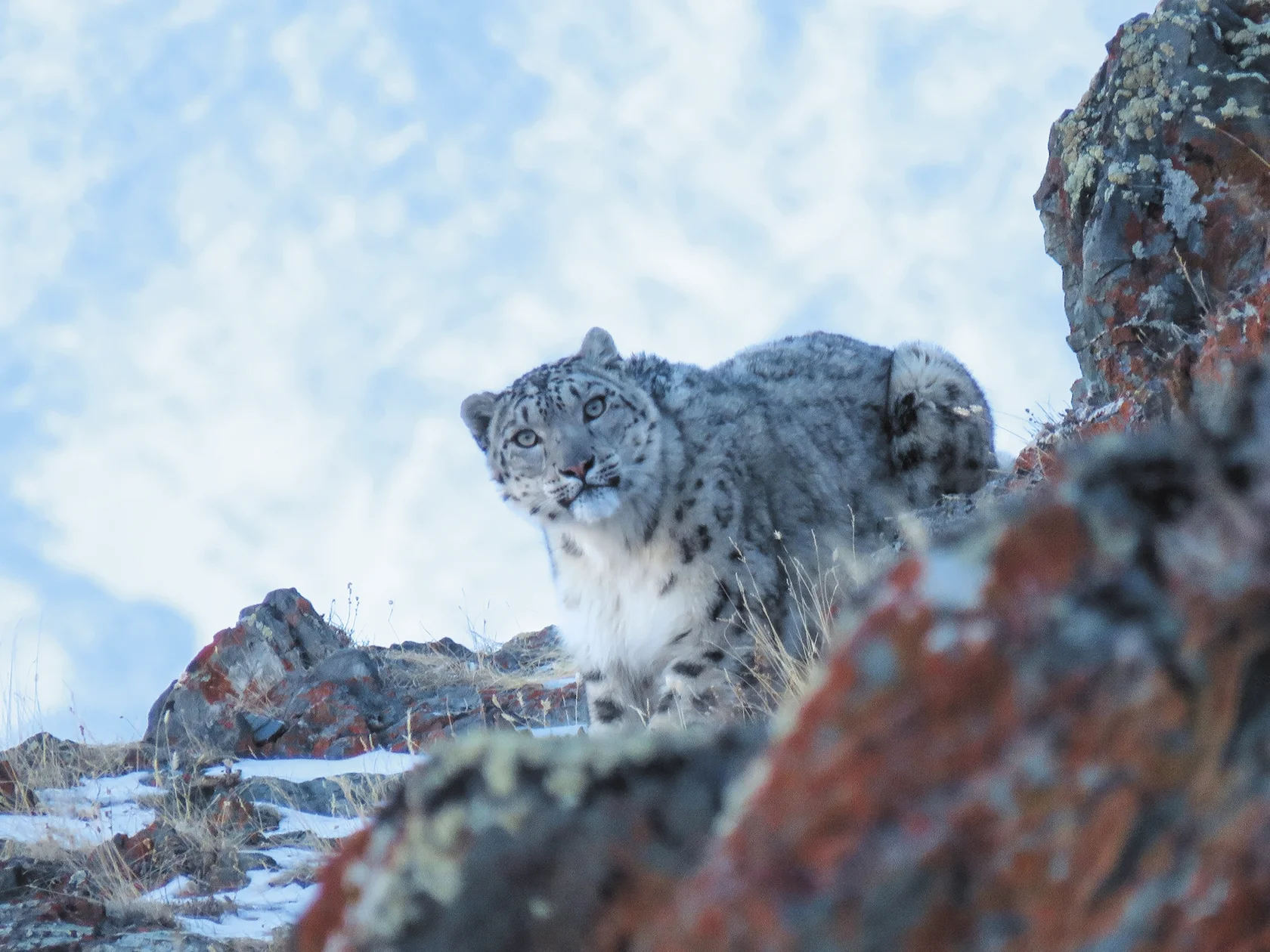
Dedicated volunteers and scientists from Russia and other countries have joined forces to preserve and restore the snow leopard population. Ali Uzdenov, Chairman of the Board of Trustees of the Interregional Association 'Centre for the Study and Conservation of the Snow Leopard Irbis' (Irbis — the Russian and Central Asian name for the snow leopard, Panthera uncia), told Evrazimut magazine how the joint work of science, business, and the international community is helping to save from extinction the most mysterious of the world’s big cats.

Ali Uzdenov — Chairman of the Board of Trustees of the Interregional Association "Irbis Center for the Study and Conservation of the Snow Leopard"
— According to the Russian Academy of Sciences, the snow leopard population in our country stood at 150−200 individuals in 2002, then fell sharply to 20−30. Today we have 87 snow leopards. How was it possible to reverse that decline?
— There is a simple rule in relations with wildlife: do no harm. Nature can recover by itself, heal itself. As for snow leopards — yes, their numbers fell catastrophically over those years. There were several reasons. First, the disturbance factor. Second, the absence of a prey base: Siberian ibex were scarce, and Marco Polo sheep (argali — Ovis ammon, the largest wild sheep in the world) were on the verge of extinction at just 300−400 individuals. Today there are four thousand in Russia alone, and as many again in Mongolia. Third, poaching — and finally, conflicts with local herders: natural competition for pasture and territory.
The main impetus for recovery was that the state began paying attention. Sailyugemsky National Park was created in the Republic of Altai and fully operational from 2012. Attention was also given to the problem in the Sayano-Shushensky Nature Reserve and Tunkinsky National Park. Numbers began to grow, slowly. The role of volunteers, science, and the dedicated people who work in nature reserves and national parks deserves special mention.
— The snow leopard’s habitat spans more than ten Eurasian countries. How is international cooperation developing in protecting these animals?
— Today snow leopards inhabit 12 Asian countries — from Russia, home to the world’s northernmost snow leopards, to Bhutan, from Uzbekistan to China. In each of these countries the snow leopard is not just a rare predator but a part of local peoples' cultures and a symbol of the Asian mountain ecosystem.
The snow leopard is a migratory species that recognises no human barriers — no border posts, no national frontiers. Snow leopards cross from one country to another along mountain ridges where they may face threats from poaching to habitat destruction. The fact that the historical range is divided among 12 states confronts the global conservation community with a stark choice: either we unite our efforts to save the symbol of the mountains, or we lose the species.
In 2012 in Bishkek, representatives of the range countries signed the Bishkek Declaration within the framework of the Global Snow Leopard and Ecosystem Protection Programme (GSLEP — the principal international platform for coordinating snow leopard conservation across all 12 range states). At the same time the International Snow Leopard Day was established: 23 October. In 2025 our Irbis Association, together with the Rais (head) of the Republic of Tatarstan Rustam Minnikhanov and Russia’s Ministry of Natural Resources, gathered representatives from the conservation systems of all 12 range countries at an International Conference in Kazan, where participants signed the Kazan Declaration on joint species protection.
In December 2025, during President Putin’s visit to India, Russia joined the International Big Cats Alliance (IBCA — launched by India in 2023 as an intergovernmental platform for the conservation of seven big cat species, including the snow leopard, tiger, lion, leopard, cheetah, puma, and jaguar). In the same month the Irbis Association signed a cooperation agreement with the Alliance. An International Big Cats Summit will take place in June, at which we too will be participating. The snow leopard is indeed capable of playing the role of a 'mountain diplomat'. 'Snow leopard diplomacy' is at work.
— The conservation and growth of the snow leopard population is one of the objectives of the national project 'Ecological Wellbeing'. How close have you come to achieving this goal?
— Today the snow leopard population in Russia stands at 87 individuals — based on the 2025 count conducted with the support of the Irbis Association. For comparison, in 2018 only 61 individuals were recorded.
I would highlight successes in some areas. Since 2018, thanks to a unique restoration programme and the translocation of individuals from another country, the nearly extinct West Sayan group has been restored — within the boundaries of the Sayano-Shushensky Nature Reserve, where 19 snow leopards now live. In the Argut River valley there are today at least 25 snow leopards — the largest single group in Russia, sustained by a large population of Siberian ibex.
A difficult — one might say critical — situation has developed in Buryatia, where only two individuals remain. A reintroduction programme will clearly be necessary there. Russia has committed to reaching a minimum of 150 snow leopards, but scientists consider that 300 individuals are needed for the population to be genetically resilient.
Threats in the form of poaching and habitat destruction persist. Falling ungulate numbers have led to more frequent snow leopard attacks on livestock. Our Association has for several years been paying compensation to the local population for damage caused by snow leopards. We are also now looking at introducing the practice of rewarding local residents for helping to protect the snow leopard.
— You said that herders need to be reconciled to living alongside snow leopards. How does that work in practice?
— Few would say the snow leopard is not needed — everyone will say it is. But for the snow leopard to exist, mountain goats and argali must exist first. A snow leopard has to eat. We are now observing a worrying downward trend in ibex numbers, possibly connected to some form of disease. We are in the final stages of agreement with Gorno-Altaisk State University and the Russian Academy of Sciences on conducting a study into this.
We carry out awareness work in the regions — with children and adults alike. We hold local snow leopard festivals. Children are our allies. For instance, after a school visit one girl stood up and said: 'My father sets traps. I’m going to go home and talk to him right now.' That is a result. Attitudes are changing — we just wish it would happen faster.
— In China, home to the largest snow leopard population, the most stringent penalties for poaching have been introduced. Should Russia tighten its legislation?
— Other countries' experience varies greatly. China has very strict laws. The core of the world snow leopard population is indeed in China: estimates range from four to five thousand individuals — more than half the global population.
The Indian approach is different: there, humans and snow leopards are friends. People living in high-altitude villages have built their lives around the snow leopard’s fame: tourists and photographers arrive, bringing accommodation, food service, guiding work, and souvenir sales. In India snow leopards are not particularly afraid of humans. You simply need to be in good physical shape to climb to four or five thousand metres.
Kyrgyzstan’s experience is instructive: they began protecting and growing the Marco Polo sheep (Ovis ammon polii — the world’s largest sheep by horn spread, a prized trophy species found in the Pamirs) population. Revenue from expensive hunting licences is divided three ways: local community, hunting organisers, and the state budget. Now everyone has an interest in the sheep thriving. And where there are sheep, there are more snow leopards — with significant population growth as a result. Bhutan’s experience: there the snow leopard is revered, and it thrives.
— The snow leopard is a virtually uncatchable animal. What scientific research has the Association made possible?
— The Irbis Association has been actively working since 2021. Today we support scientific research, anti-poaching work, ecological education, and large-scale international projects — not only for the snow leopard but for the Pallas’s cat (manul — Otocolobus manul, a small wild cat of Central Asia), the Altai mountain sheep (argali), the saker falcon (sokol-baloban — a large falcon used in falconry, listed as Endangered on the IUCN Red List), and the Siberian musk deer (kabarga). We support scientific expeditions in each of the four regions where the snow leopard lives: Krasnoyarsk Krai and the Republics of Altai, Buryatia, and Tuva.
This year, on our initiative, the first catalogue of individual snow leopards in Russia was published — Snow Leopards of Russia — gathering stories, photographs, and data on all wild snow leopards known to science, as well as information on individuals held in the country’s zoos. Together with Sber we are developing a unique information and analytics platform for the snow leopard, where modern technology helps to aggregate, systematise, and more effectively analyse the data.
— Can the cause of snow leopard conservation become a positive point of contact between Russia and other countries — including unfriendly ones?
— There is now the International Big Cats Alliance — something like a United Nations for these animals. Snow leopards are kept in many zoos around the world. Genetic pairing must be done carefully to produce viable offspring. This work is carried out very well at Cologne Zoo, for instance. Moscow Zoo has a breeding pair — Dayna and Untsik. Novosibirsk and Perm zoos are producing good offspring, and Nizhny Novgorod Zoo has now also begun working with snow leopards. Zoos are the species' 'genetic refrigerator'.
Even in Afghanistan, while filming, we obtained unique footage. A snow leopard had broken into a sheep pen; it was locked in, and the whole village held an assembly to decide its fate — release or execution. Like something from a Roman amphitheatre.
— Did they let it go?
— By a majority vote — they did. We have unique footage of it running to freedom. Many of our own citizens do not know that the snow leopard exists in Russia. We held a large exhibition at the Tretyakov Gallery (the Tretyakov Gallery in Moscow — Russia’s principal museum of national fine art). Many visitors were surprised to learn that the snow leopard lives in our country. They thought it lived 'somewhere out there'.
— You became general producer of the documentary film The Master of the Altai Mountains. Tell us about the filming.
— Filming the first full-length documentary about snow leopards in Russia was a serious ordeal for our entire team of more than 40 people, including scientists and rangers from Sailyugemsky National Park who became the film’s subjects.
We encountered countless difficulties: severe cold, biting wind, altitude sickness. At times we had to wait for long periods in hiding, unable to light a fire for fear of disturbing the animal. There were also absurd moments — on the very first night, a bear dismantled the caravan prepared for our use. We expected filming to take no more than six months, but no one had ever filmed a snow leopard in the Russian wild before. We were pioneers. In the end filming stretched over three years.
We succeeded in telling the moving story of the snow leopard cub Tural and his family. I am glad that it became a warm and proper family film, narrated by the legendary Nikolai Nikolayevich Drozdov (the beloved Russian naturalist and television presenter, host of the long-running programme In the Animal World) and actor Konstantin Khabensky. The film has been recognised at more than 20 Russian and international film festivals, including in Mexico, Spain, and the United Kingdom.
We are now, with the financial support of VTB, filming an international project under the working title People and Snow Leopards — a unique film about the snow leopard and the people who protect, study, and love it, covering all 12 countries of the snow leopard’s range.
— One gets the impression that for you personally the snow leopard is something more than a commission or a presidential advisory role. What does this beautiful, secretive big cat mean to you?
— These are childhood impressions. Mountains — I grew up in the mountains. A most beautiful and mysterious animal. For humans the snow leopard is almost harmless. Leave it alone and it will always walk away. It will not attack unless cornered.
I want the snow leopard question to be settled — I want us to stop saying it is disappearing. There is a good example: the Amur tiger and the Far Eastern leopard. Respect to those who did that work. With the snow leopard it is harder — it lives high in the mountains. But it is an extraordinarily beautiful predator, and it must be preserved.
— There is a simple rule in relations with wildlife: do no harm. Nature can recover by itself, heal itself. As for snow leopards — yes, their numbers fell catastrophically over those years. There were several reasons. First, the disturbance factor. Second, the absence of a prey base: Siberian ibex were scarce, and Marco Polo sheep (argali — Ovis ammon, the largest wild sheep in the world) were on the verge of extinction at just 300−400 individuals. Today there are four thousand in Russia alone, and as many again in Mongolia. Third, poaching — and finally, conflicts with local herders: natural competition for pasture and territory.
The main impetus for recovery was that the state began paying attention. Sailyugemsky National Park was created in the Republic of Altai and fully operational from 2012. Attention was also given to the problem in the Sayano-Shushensky Nature Reserve and Tunkinsky National Park. Numbers began to grow, slowly. The role of volunteers, science, and the dedicated people who work in nature reserves and national parks deserves special mention.
— The snow leopard’s habitat spans more than ten Eurasian countries. How is international cooperation developing in protecting these animals?
— Today snow leopards inhabit 12 Asian countries — from Russia, home to the world’s northernmost snow leopards, to Bhutan, from Uzbekistan to China. In each of these countries the snow leopard is not just a rare predator but a part of local peoples' cultures and a symbol of the Asian mountain ecosystem.
The snow leopard is a migratory species that recognises no human barriers — no border posts, no national frontiers. Snow leopards cross from one country to another along mountain ridges where they may face threats from poaching to habitat destruction. The fact that the historical range is divided among 12 states confronts the global conservation community with a stark choice: either we unite our efforts to save the symbol of the mountains, or we lose the species.
In 2012 in Bishkek, representatives of the range countries signed the Bishkek Declaration within the framework of the Global Snow Leopard and Ecosystem Protection Programme (GSLEP — the principal international platform for coordinating snow leopard conservation across all 12 range states). At the same time the International Snow Leopard Day was established: 23 October. In 2025 our Irbis Association, together with the Rais (head) of the Republic of Tatarstan Rustam Minnikhanov and Russia’s Ministry of Natural Resources, gathered representatives from the conservation systems of all 12 range countries at an International Conference in Kazan, where participants signed the Kazan Declaration on joint species protection.
In December 2025, during President Putin’s visit to India, Russia joined the International Big Cats Alliance (IBCA — launched by India in 2023 as an intergovernmental platform for the conservation of seven big cat species, including the snow leopard, tiger, lion, leopard, cheetah, puma, and jaguar). In the same month the Irbis Association signed a cooperation agreement with the Alliance. An International Big Cats Summit will take place in June, at which we too will be participating. The snow leopard is indeed capable of playing the role of a 'mountain diplomat'. 'Snow leopard diplomacy' is at work.
— The conservation and growth of the snow leopard population is one of the objectives of the national project 'Ecological Wellbeing'. How close have you come to achieving this goal?
— Today the snow leopard population in Russia stands at 87 individuals — based on the 2025 count conducted with the support of the Irbis Association. For comparison, in 2018 only 61 individuals were recorded.
I would highlight successes in some areas. Since 2018, thanks to a unique restoration programme and the translocation of individuals from another country, the nearly extinct West Sayan group has been restored — within the boundaries of the Sayano-Shushensky Nature Reserve, where 19 snow leopards now live. In the Argut River valley there are today at least 25 snow leopards — the largest single group in Russia, sustained by a large population of Siberian ibex.
A difficult — one might say critical — situation has developed in Buryatia, where only two individuals remain. A reintroduction programme will clearly be necessary there. Russia has committed to reaching a minimum of 150 snow leopards, but scientists consider that 300 individuals are needed for the population to be genetically resilient.
Threats in the form of poaching and habitat destruction persist. Falling ungulate numbers have led to more frequent snow leopard attacks on livestock. Our Association has for several years been paying compensation to the local population for damage caused by snow leopards. We are also now looking at introducing the practice of rewarding local residents for helping to protect the snow leopard.
— You said that herders need to be reconciled to living alongside snow leopards. How does that work in practice?
— Few would say the snow leopard is not needed — everyone will say it is. But for the snow leopard to exist, mountain goats and argali must exist first. A snow leopard has to eat. We are now observing a worrying downward trend in ibex numbers, possibly connected to some form of disease. We are in the final stages of agreement with Gorno-Altaisk State University and the Russian Academy of Sciences on conducting a study into this.
We carry out awareness work in the regions — with children and adults alike. We hold local snow leopard festivals. Children are our allies. For instance, after a school visit one girl stood up and said: 'My father sets traps. I’m going to go home and talk to him right now.' That is a result. Attitudes are changing — we just wish it would happen faster.
— In China, home to the largest snow leopard population, the most stringent penalties for poaching have been introduced. Should Russia tighten its legislation?
— Other countries' experience varies greatly. China has very strict laws. The core of the world snow leopard population is indeed in China: estimates range from four to five thousand individuals — more than half the global population.
The Indian approach is different: there, humans and snow leopards are friends. People living in high-altitude villages have built their lives around the snow leopard’s fame: tourists and photographers arrive, bringing accommodation, food service, guiding work, and souvenir sales. In India snow leopards are not particularly afraid of humans. You simply need to be in good physical shape to climb to four or five thousand metres.
Kyrgyzstan’s experience is instructive: they began protecting and growing the Marco Polo sheep (Ovis ammon polii — the world’s largest sheep by horn spread, a prized trophy species found in the Pamirs) population. Revenue from expensive hunting licences is divided three ways: local community, hunting organisers, and the state budget. Now everyone has an interest in the sheep thriving. And where there are sheep, there are more snow leopards — with significant population growth as a result. Bhutan’s experience: there the snow leopard is revered, and it thrives.
— The snow leopard is a virtually uncatchable animal. What scientific research has the Association made possible?
— The Irbis Association has been actively working since 2021. Today we support scientific research, anti-poaching work, ecological education, and large-scale international projects — not only for the snow leopard but for the Pallas’s cat (manul — Otocolobus manul, a small wild cat of Central Asia), the Altai mountain sheep (argali), the saker falcon (sokol-baloban — a large falcon used in falconry, listed as Endangered on the IUCN Red List), and the Siberian musk deer (kabarga). We support scientific expeditions in each of the four regions where the snow leopard lives: Krasnoyarsk Krai and the Republics of Altai, Buryatia, and Tuva.
This year, on our initiative, the first catalogue of individual snow leopards in Russia was published — Snow Leopards of Russia — gathering stories, photographs, and data on all wild snow leopards known to science, as well as information on individuals held in the country’s zoos. Together with Sber we are developing a unique information and analytics platform for the snow leopard, where modern technology helps to aggregate, systematise, and more effectively analyse the data.
— Can the cause of snow leopard conservation become a positive point of contact between Russia and other countries — including unfriendly ones?
— There is now the International Big Cats Alliance — something like a United Nations for these animals. Snow leopards are kept in many zoos around the world. Genetic pairing must be done carefully to produce viable offspring. This work is carried out very well at Cologne Zoo, for instance. Moscow Zoo has a breeding pair — Dayna and Untsik. Novosibirsk and Perm zoos are producing good offspring, and Nizhny Novgorod Zoo has now also begun working with snow leopards. Zoos are the species' 'genetic refrigerator'.
Even in Afghanistan, while filming, we obtained unique footage. A snow leopard had broken into a sheep pen; it was locked in, and the whole village held an assembly to decide its fate — release or execution. Like something from a Roman amphitheatre.
— Did they let it go?
— By a majority vote — they did. We have unique footage of it running to freedom. Many of our own citizens do not know that the snow leopard exists in Russia. We held a large exhibition at the Tretyakov Gallery (the Tretyakov Gallery in Moscow — Russia’s principal museum of national fine art). Many visitors were surprised to learn that the snow leopard lives in our country. They thought it lived 'somewhere out there'.
— You became general producer of the documentary film The Master of the Altai Mountains. Tell us about the filming.
— Filming the first full-length documentary about snow leopards in Russia was a serious ordeal for our entire team of more than 40 people, including scientists and rangers from Sailyugemsky National Park who became the film’s subjects.
We encountered countless difficulties: severe cold, biting wind, altitude sickness. At times we had to wait for long periods in hiding, unable to light a fire for fear of disturbing the animal. There were also absurd moments — on the very first night, a bear dismantled the caravan prepared for our use. We expected filming to take no more than six months, but no one had ever filmed a snow leopard in the Russian wild before. We were pioneers. In the end filming stretched over three years.
We succeeded in telling the moving story of the snow leopard cub Tural and his family. I am glad that it became a warm and proper family film, narrated by the legendary Nikolai Nikolayevich Drozdov (the beloved Russian naturalist and television presenter, host of the long-running programme In the Animal World) and actor Konstantin Khabensky. The film has been recognised at more than 20 Russian and international film festivals, including in Mexico, Spain, and the United Kingdom.
We are now, with the financial support of VTB, filming an international project under the working title People and Snow Leopards — a unique film about the snow leopard and the people who protect, study, and love it, covering all 12 countries of the snow leopard’s range.
— One gets the impression that for you personally the snow leopard is something more than a commission or a presidential advisory role. What does this beautiful, secretive big cat mean to you?
— These are childhood impressions. Mountains — I grew up in the mountains. A most beautiful and mysterious animal. For humans the snow leopard is almost harmless. Leave it alone and it will always walk away. It will not attack unless cornered.
I want the snow leopard question to be settled — I want us to stop saying it is disappearing. There is a good example: the Amur tiger and the Far Eastern leopard. Respect to those who did that work. With the snow leopard it is harder — it lives high in the mountains. But it is an extraordinarily beautiful predator, and it must be preserved.
The interview was conducted by Tatiana Antonova
The Snow Leopard: A Return to the Homeland
In summer 2025 Kyrgyzstan transferred three snow leopards to the Republic of Altai. Kanatbek Abdrakhmanov, President of the National Academy of Sciences of Kyrgyzstan from 2022 to 2026 and Director of the Seismology Institute of the Kyrgyz National Academy of Sciences, told Evrazimut magazine about the hidden meaning of this gift — and why Kyrgyz people consider the snow leopard (irbis — the Kyrgyz and Central Asian name for Panthera uncia) a kinsman.
— Kyrgyzstan is one of twelve countries in the world where snow leopards live. What measures are being taken to conserve and restore the population?
— Our snow leopard numbers have increased. I will not give specific figures right now, as we are in the middle of the latest field surveys to count the animals. But the population growth is connected to the adoption of a special law on snow leopard protection. The snow leopard also appears in many official documents as a talisman. This year we are hosting the World Nomad Games (the international sporting festival celebrating the traditions of nomadic and semi-nomadic peoples of Eurasia, held every two years), and the snow leopard is the official symbol of this major celebration. In Kyrgyzstan the snow leopard holds a very special place. Hunting it is prohibited by law.
— Our snow leopard numbers have increased. I will not give specific figures right now, as we are in the middle of the latest field surveys to count the animals. But the population growth is connected to the adoption of a special law on snow leopard protection. The snow leopard also appears in many official documents as a talisman. This year we are hosting the World Nomad Games (the international sporting festival celebrating the traditions of nomadic and semi-nomadic peoples of Eurasia, held every two years), and the snow leopard is the official symbol of this major celebration. In Kyrgyzstan the snow leopard holds a very special place. Hunting it is prohibited by law.
Background: Kyrgyzstan is recognised as the country with the highest density of snow leopard habitat in the world. According to a four-year study conducted in the Tian Shan with support from the Snow Leopard Trust (SLT — the US-based NGO that has been leading scientific snow leopard research in Central Asia since 1981), the snow leopard population in the country as of 2025 stood at 234 to 349 individuals. Other estimates put the number at 459.
— In many snow leopard range countries the prey base — ungulates — is a critical problem. What is the situation in Kyrgyzstan?
— The snow leopard does indeed need a prey base. You can’t deliver pies on a tray to it — it is an independent sort of fellow, must hunt for itself. Our Siberian ibex (Capra sibirica — the main prey species of the snow leopard in Central Asia) numbers have risen sharply. Social media is now constantly full of photographs and videos of people who simply went for a walk in the mountains and filmed ibex. They have even started appearing on highways. This happened because a law was passed to protect animals listed in the Red Book. Siberian ibex are on it, and in Kyrgyzstan this is now taken very seriously and enforced with rigour.
— The largest snow leopard population lives in China, where poaching carries very severe penalties. How applicable is that experience to Kyrgyzstan?
— Our laws are, of course, less severe than China’s. But we have fairly strict criminal liability for poaching. In the past several years, however, I have not once heard of anyone trying to sell a snow leopard skin. There has been substantial public awareness work about the snow leopard being a symbol of the Kyrgyz people. It is a noble, beautiful animal. We are following the path of education, seeking to instil in people a fraternal attitude toward this animal. If it is a symbol of our people, then to kill it is a sacrilege.
People have responded well. I know several cases where people apprehended poachers themselves and reported: ‘This man was walking in the area where we had seen a snow leopard.' That is the right approach. If people come to treat the snow leopard as a kindred being, as the embodiment of the Kyrgyz people — that is a very powerful message.
Background: In September 2024, at the 79th Session of the UN General Assembly, Kyrgyzstan initiated a resolution to declare 23 October the International Snow Leopard Day. The resolution was adopted unanimously, with 62 co-sponsoring countries including Azerbaijan, Afghanistan, India, Kazakhstan, China, Pakistan, Russia, Tajikistan, Turkmenistan, and Uzbekistan. The purpose: to draw global attention to the challenge of conserving this predator and to stimulate international cooperation.
— How is cooperation with Russian scientists and conservation advocates progressing?
— Last year I was in Moscow and met with colleagues from Tatarstan. I learned then that the snow leopard is the official symbol of the Republic of Tatarstan (the snow leopard has been the symbol of Tatarstan and of its capital Kazan since the medieval period — it appears on the coat of arms), and I asked: ‘But does the snow leopard actually live in your region?' It turned out it does not. I then proposed that Kyrgyzstan and Tatarstan ‘become family friends' and work together. This year we plan to conclude an agreement on the joint study and conservation of the snow leopard and the monitoring of its habitat.
Kyrgyzstan also recently transferred three snow leopards to the Republic of Altai — and this was done with a particular meaning behind it. According to one historical hypothesis, the Kyrgyz people came from Altai to the Tian Shan (the great mountain system of Central Asia that runs through Kyrgyzstan, Kazakhstan, and western China). The prevailing view is that the Kyrgyz people lived in Altai from ancient times but, being a nomadic people, moved back and forth, eventually settling in the Tian Shan. There were also purely political reasons: on one side, Russia began opening up Siberia; on the other, China established its borders. As a result, the Kyrgyz found themselves remaining in the Tian Shan. But by ancestry — we are an Altai people. This gift carried a hidden meaning: we Kyrgyz are sending the snow leopards back to our historical homeland.
— The snow leopard does indeed need a prey base. You can’t deliver pies on a tray to it — it is an independent sort of fellow, must hunt for itself. Our Siberian ibex (Capra sibirica — the main prey species of the snow leopard in Central Asia) numbers have risen sharply. Social media is now constantly full of photographs and videos of people who simply went for a walk in the mountains and filmed ibex. They have even started appearing on highways. This happened because a law was passed to protect animals listed in the Red Book. Siberian ibex are on it, and in Kyrgyzstan this is now taken very seriously and enforced with rigour.
— The largest snow leopard population lives in China, where poaching carries very severe penalties. How applicable is that experience to Kyrgyzstan?
— Our laws are, of course, less severe than China’s. But we have fairly strict criminal liability for poaching. In the past several years, however, I have not once heard of anyone trying to sell a snow leopard skin. There has been substantial public awareness work about the snow leopard being a symbol of the Kyrgyz people. It is a noble, beautiful animal. We are following the path of education, seeking to instil in people a fraternal attitude toward this animal. If it is a symbol of our people, then to kill it is a sacrilege.
People have responded well. I know several cases where people apprehended poachers themselves and reported: ‘This man was walking in the area where we had seen a snow leopard.' That is the right approach. If people come to treat the snow leopard as a kindred being, as the embodiment of the Kyrgyz people — that is a very powerful message.
Background: In September 2024, at the 79th Session of the UN General Assembly, Kyrgyzstan initiated a resolution to declare 23 October the International Snow Leopard Day. The resolution was adopted unanimously, with 62 co-sponsoring countries including Azerbaijan, Afghanistan, India, Kazakhstan, China, Pakistan, Russia, Tajikistan, Turkmenistan, and Uzbekistan. The purpose: to draw global attention to the challenge of conserving this predator and to stimulate international cooperation.
— How is cooperation with Russian scientists and conservation advocates progressing?
— Last year I was in Moscow and met with colleagues from Tatarstan. I learned then that the snow leopard is the official symbol of the Republic of Tatarstan (the snow leopard has been the symbol of Tatarstan and of its capital Kazan since the medieval period — it appears on the coat of arms), and I asked: ‘But does the snow leopard actually live in your region?' It turned out it does not. I then proposed that Kyrgyzstan and Tatarstan ‘become family friends' and work together. This year we plan to conclude an agreement on the joint study and conservation of the snow leopard and the monitoring of its habitat.
Kyrgyzstan also recently transferred three snow leopards to the Republic of Altai — and this was done with a particular meaning behind it. According to one historical hypothesis, the Kyrgyz people came from Altai to the Tian Shan (the great mountain system of Central Asia that runs through Kyrgyzstan, Kazakhstan, and western China). The prevailing view is that the Kyrgyz people lived in Altai from ancient times but, being a nomadic people, moved back and forth, eventually settling in the Tian Shan. There were also purely political reasons: on one side, Russia began opening up Siberia; on the other, China established its borders. As a result, the Kyrgyz found themselves remaining in the Tian Shan. But by ancestry — we are an Altai people. This gift carried a hidden meaning: we Kyrgyz are sending the snow leopards back to our historical homeland.
АТАSS!
In spring, TASS and the International Association Irbis (Irbis — the Russian and Central Asian name for the snow leopard, Panthera uncia) held an all-Russian competition among schoolchildren for the best name for a snow leopard. The final choice was put to the subscribers of NYUM TASS — the agency’s new youth media project.
133 participants from more than 40 cities across the country entered the competition. The vote concluded on 15 May with the victory of Ulyana Sergiyenko, a schoolgirl from Krasnoyarsk — the great wild cat has been given the name Atass. NYUM TASS spoke with the ninth-grader.
— What do you know about TASS?
— For me it is the principal news outlet in Russia. When I need to check a fact, I go to the TASS feed first. I trust the oldest news agency, with its 120‑year history and its vast network of correspondents around the world, one hundred percent.
— Why did you decide to enter the competition?
— I love animals and nature, and the incredibly beautiful photographs of the snow leopard caught my attention! I decided to take part in this genuinely good project because I want to contribute to the protection of a rare species.
— 'Atass' and 'TASS' rhyme. How did you come up with the name?
— The idea of the name Atass came to me straight away: I was looking for something short and energetic. The word atas (atas — Russian youth slang derived from a Turkic exclamation, used to mean 'danger ahead', 'watch out', or 'wow' — connoting sudden movement, excitement, and speed) is associated with drive and speed. And when I realised that adding an 's' would make it rhyme with TASS — there were no other options after that.
— And what do you know about snow leopards?
— Snow leopards are called 'ghosts of the mountains' for good reason — they are secretive and on the edge of extinction. I think it is exactly right when major, authoritative media organisations like TASS take care of those who need help. It draws attention to the problem and gives a chance to preserve a rare species.
Ulyana Sergiyenko will receive an exclusive gift featuring Atass and will visit the country’s leading news agency.
The leopard’s name will be announced at the St. Petersburg International Economic Forum. He is to become 'TASS's special correspondent in the wild'. The agency, together with the Interregional Association 'Centre for the Study and Conservation of the Snow Leopard Irbis', will closely follow the leopard and tell the wider public about his life.
— For me it is the principal news outlet in Russia. When I need to check a fact, I go to the TASS feed first. I trust the oldest news agency, with its 120‑year history and its vast network of correspondents around the world, one hundred percent.
— Why did you decide to enter the competition?
— I love animals and nature, and the incredibly beautiful photographs of the snow leopard caught my attention! I decided to take part in this genuinely good project because I want to contribute to the protection of a rare species.
— 'Atass' and 'TASS' rhyme. How did you come up with the name?
— The idea of the name Atass came to me straight away: I was looking for something short and energetic. The word atas (atas — Russian youth slang derived from a Turkic exclamation, used to mean 'danger ahead', 'watch out', or 'wow' — connoting sudden movement, excitement, and speed) is associated with drive and speed. And when I realised that adding an 's' would make it rhyme with TASS — there were no other options after that.
— And what do you know about snow leopards?
— Snow leopards are called 'ghosts of the mountains' for good reason — they are secretive and on the edge of extinction. I think it is exactly right when major, authoritative media organisations like TASS take care of those who need help. It draws attention to the problem and gives a chance to preserve a rare species.
Ulyana Sergiyenko will receive an exclusive gift featuring Atass and will visit the country’s leading news agency.
The leopard’s name will be announced at the St. Petersburg International Economic Forum. He is to become 'TASS's special correspondent in the wild'. The agency, together with the Interregional Association 'Centre for the Study and Conservation of the Snow Leopard Irbis', will closely follow the leopard and tell the wider public about his life.