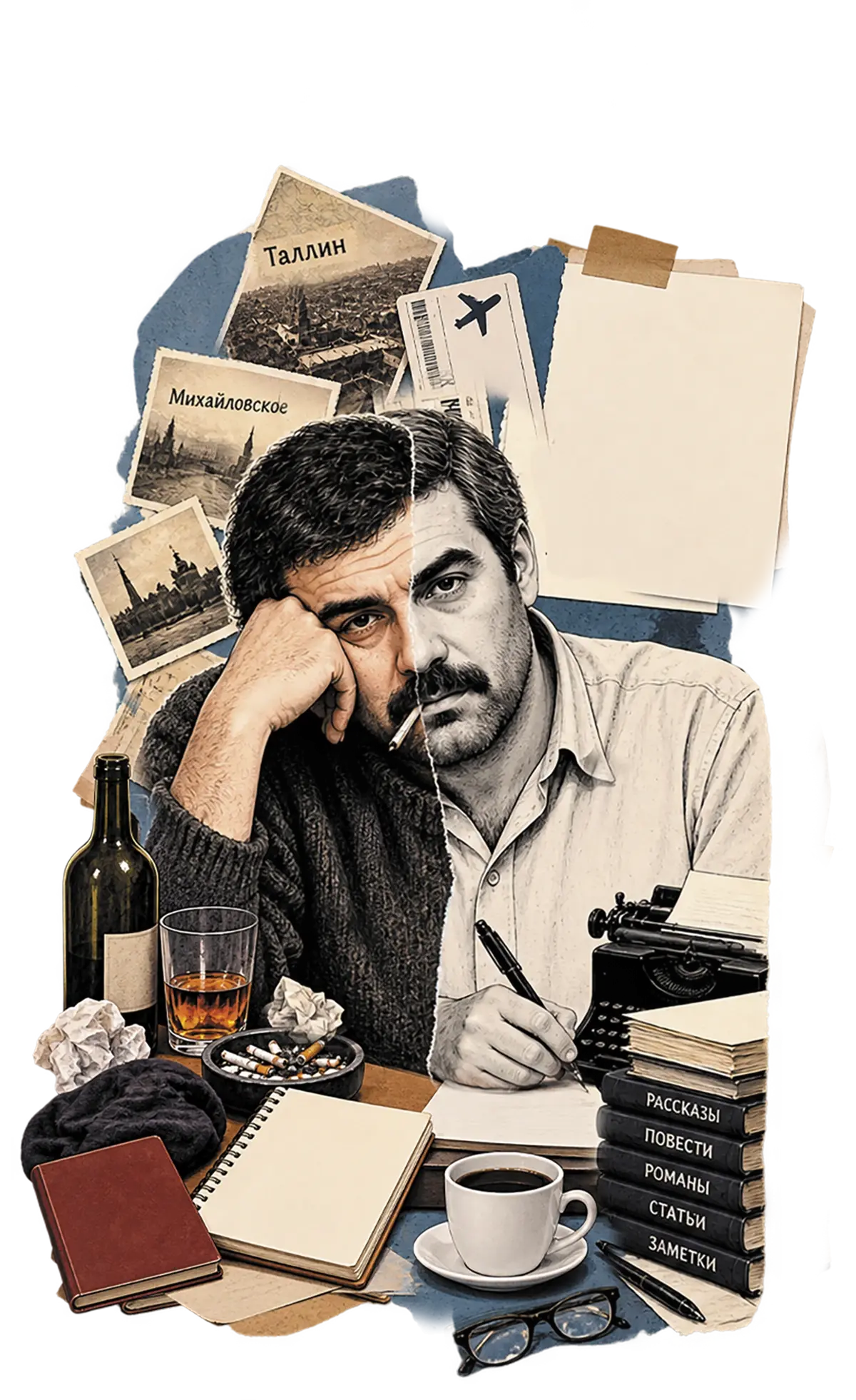
Dovlatov — just look at any photograph of him — was a handsome giant of a man. Once, in a fit of temper, he lifted the back end of a rival's car, rival and all, and held it aloft for a while, weighing his options, before setting it back down and granting his rival his life. With gifts like that, he could have ruled and given orders! Instead he chose a path of suffering and failure. Or did failure choose him, to show off its own power? He never finished (dropped out of university), never quite loved through to the end (he kept parting from the women he loved), never served out his term (he was transferred from the labor camp to Leningrad), never wrote his weighty collected works, never lived to see a comfortable life or official recognition. So why is it that in this great city, which raises only geniuses onto pedestals, the monument to Dovlatov — with no pedestal at all — is the best loved and most popular, especially among the young, who, as we know, choose their own idols? What did he do to please them all so much? I think it was his failures. Life, of course, can never quite match the legend — especially a legend in which defeat is more honest than victory, more human, more desirable. But the author has no right to accept defeat. Turning a failure's existence into successful literature takes craft and persistence, and this is what always set the author apart from his hero. There was also a lesser-known Dovlatov, one who could never have become a literary hero — a pedant, a stickler, a workaholic, with a schedule pinned above his desk and carried out no matter what. In the hands of the finest craftsman of his time, every "failure" (indisputable, by any reasonable standard) turned into a masterpiece. Getting tмhrown out of university and serving in the worst possible role — prison-camp guard — became "The Zone"; his disgraceful — by his own reckoning — years as a journalist in Tallinn became "The Compromise"; his wretched, penny-counting existence at Mikhailovskoye became "Pushkin Hills." To show idlers in all their glory, Dovlatov worked long and furiously; he could not abide sloppiness, and his stories, which mimic an easy, lazy brevity, are the fruit of enormous labor. Bloody-minded inertia — the laziest possible form of resistance to force — reaches virtuoso heights in Dovlatov's characters: the summit of absurdity, the absolute of art… Take, for instance, my favorite, "The Belt with the Officer's Buckle," in which the hero himself coaches the soldier who split his head open on how to talk his way out of it — and the soldier… proudly disdains the offer. Let me borrow a comparison close to the story's own characters: the plot is as tightly machined as a Kalashnikov rifle. Dovlatov is a master beyond compare. So much for poor unfortunates! Look how far they've risen! A hard-luck drunk, a hero who fails at everything (because his conscience won't let him do what needs doing) — and one of the most productive writers of his generation, one who cut his own path quite ruthlessly and used the people around him quite unceremoniously — both lived inside the same body. And the body could not bear such a split. He fell, dying the death of his own outcast hero, on duty, so to speak — no insurance, no bank account, nothing but loose change in his pockets, turned away from the hospital… until at last they took him in — too late. He wanted none of those certificates of prosperity and good standing without which you cannot get by in America — and soon, it seems, won't be able to get by here either. That is why the monument on Rubinstein Street is so dear to us — a monument to a loser, one that grants people the right to fail, a last refuge in this life. Who else can you take that to? Only to him. "Seryoga! You're the only one we've got! Come here, let's hug it out!" In an age of utterly merciless office discipline that gives you no room to breathe, I think even perfectionists and career-climbers cling to Dovlatov, if only to feel, for a moment, like a free-and-easy good-for-nothing, the outcast of "Pushkin Hills" — terrible and fearless — and to believe: I could do that too! And then go calmly back to work. Life needs an outlet. Dovlatov is that outlet. Of our whole vast era — and this is astonishing — what has survived is Dovlatov's hero alone, everyone's favorite, heir to "all his nearest kin": at his side stand Rabelais's characters, the soldier Švejk, Ivanushka on the stove, and Yevgeny, victim of "magnificent Petersburg." How could we do without them? Marcel Proust was right: "Of every age, only the grotesque survives."