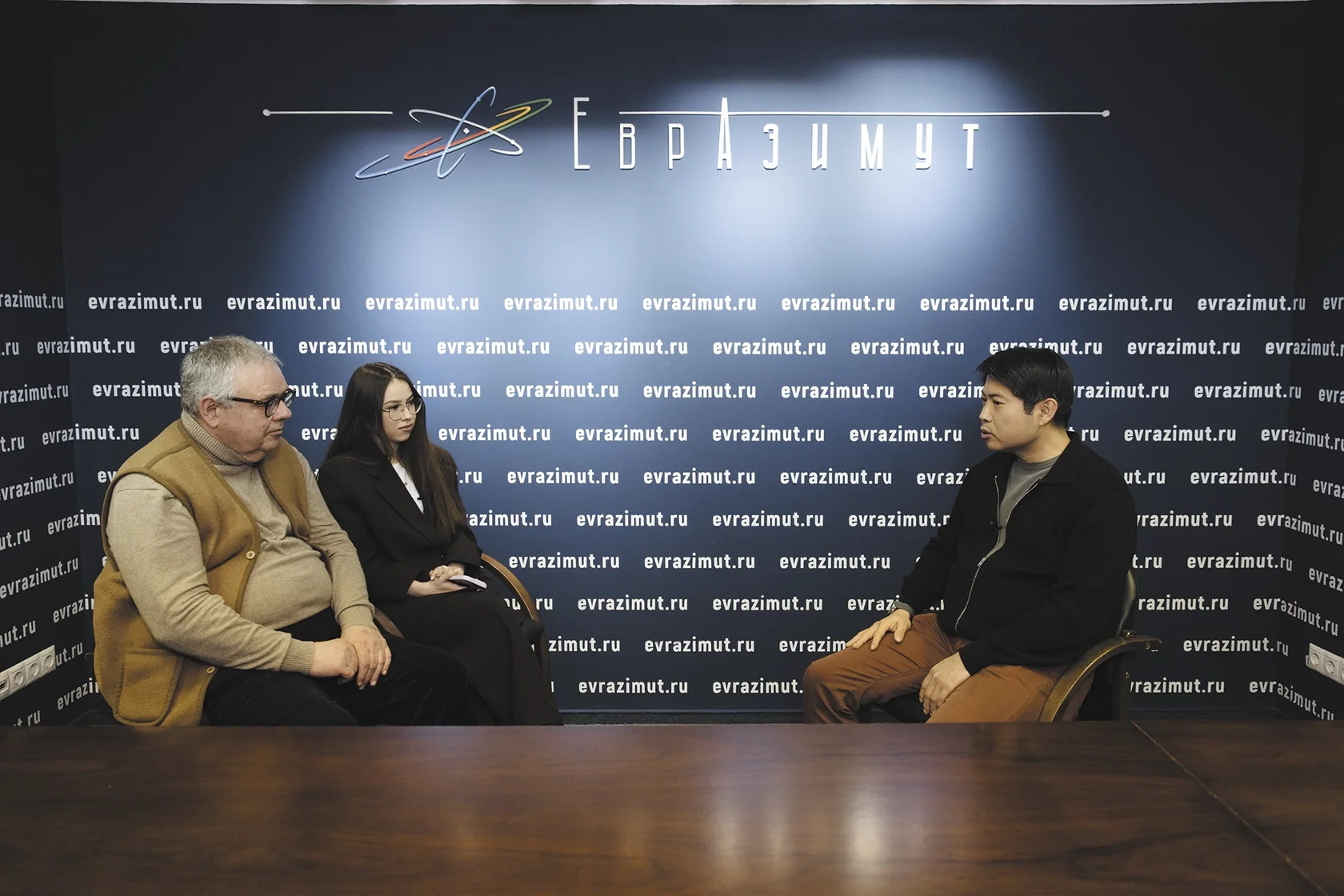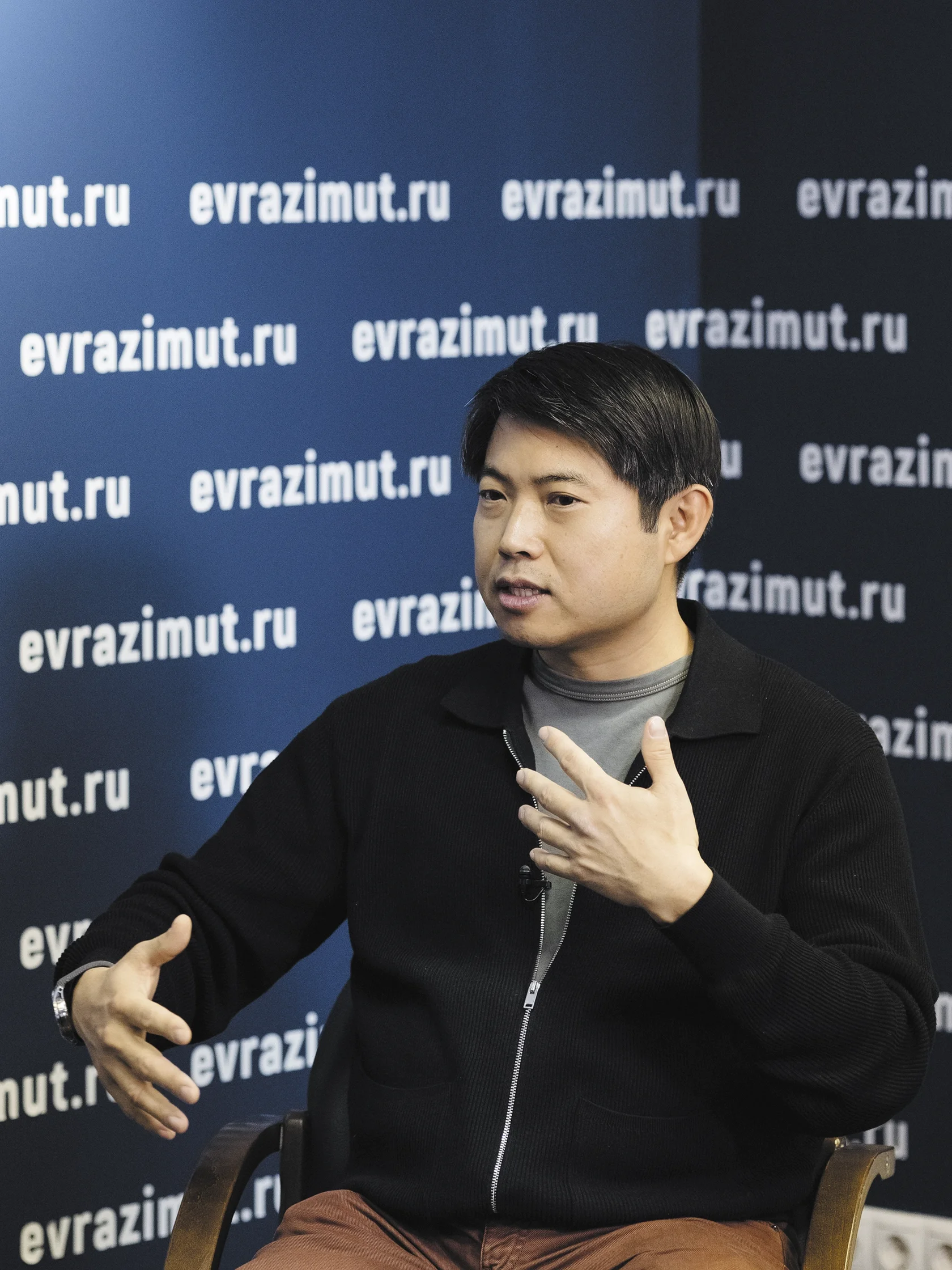
An interview with Alexander Kim, Rector of the Skolkovo School of Management
What the Moscow School of Management Skolkovo Is — and Why Adults Go Back to Study
— Our audience is mixed: some have known about you for a long time, others are hearing the name for the first time, and some are right now weighing up whether to study or not. How would you yourself explain what Skolkovo Business School is?
— The question is both simple and very complex. It is like asking someone to describe their country in two sentences — a country with Moscow, the Far East, the Northern Lights, mountains in the south, seas, rivers — and yet it is hard to convey any of that in a couple of words.
The School is the same. In the briefest possible terms, the Moscow School of Management Skolkovo is a place that people of all ages come to: from 'young adults' who have just left secondary school and are getting their first degree, to mature executives in the '60+' category. Here, they continue learning and developing — not only as managers and business people, but above all as human beings.
— But what can you teach a person who has already tried many things, made mistakes, earned money, and achieved something?
— We have two main areas of work. The first is entrepreneurs, executives, people who have already achieved a great deal in their careers — and who are now asking themselves: where to from here? For instance, how to move from one level of management to the next.
Very often a person comes to us not for career advancement. They come with the feeling that they need to make the next big step — not just to hold a position, but to do something that matters. Something their children will be able to tell stories about. Something that gives their work meaning.
— So, people come to you not only for skills but for an answer to the question 'what for'?
— Precisely. And I would not say that we plant these thoughts in people’s heads. They are usually already there. It is simply that in everyday life a person rarely has the opportunity or the space to think calmly about the future. We help to create that space.
I sometimes call this pragmatic inspiration. Inspiration, because it matters to wake up in the morning wit a sense of energy and interest in what you do. And pragmatic, because all of this rests on perfectly concrete tools: strategy, marketing, finance, management models. We do not say abstractly: 'Find yourself.' We provide people with tools that help them work through their own challenges. How to evaluate a project. How to build a strategy. How to make decisions. How to manage people. And through these tools, people begin to see both business and themselves differently.
— So, the tools are more like a lens?
— Yes, that is a good word. Because success is very hard to reduce to algorithms. There is no formula which guarantees that if you do one thing, then another, then a third, you will be happy and successful. There is no universal recipe.
So, we never say: 'Come to us and life will become perfect.' We say something different: education increases the probability that a person will be able to achieve what they want.
I like the word 'luck'. But luck is not magic. It is the situation where life throws you an opportunity and you are ready for it. That is the job of a good school. First, to raise the level of readiness — so that a person understands numbers, strategies, and processes better, and becomes professionally stronger. Second, to multiply the number of chances — because a person gains new connections, new people, new ways of thinking. But after that, it is always down to the individual.
And this applies equally to adults and to our recent bachelor’s graduates. No one will hand you success on a silver platter. You have to work. But if a person genuinely works and develops, life usually gives them a chance.
— The younger generation sometimes lacks experience in overcoming difficulties. Life has become more comfortable. Do you encounter this?
— Yes, and within the School we debate a great deal about how a person actually develops. There is a view that development is only possible through crisis and overcoming — through challenge, through pressure.
But there is another mechanism — the environment. Not in the fashionable sense of 'your circle', but in the pedagogical sense of the zone of proximal development (Lev Vygotsky’s concept: the space between what a learner can do independently and what they can achieve with guidance or peer support). A child sees that someone nearby can already ride a bicycle, and starts to believe they can too. The same thing happens with adults.
A huge part of learning comes not from the professor but from the people around you. Someone describes how they made a difficult decision, how they changed their life. And a person thinks: 'Wait — I could do that too.' We roughly divide it like this: a third of development comes from the teacher, a third from independent work, and another third from the people around you. Because the environment has an extraordinarily powerful influence.
There is involuntary overcoming — a dog chases you, and you have no choice but to run. And there is voluntary overcoming: you signed yourself up for a running group and move forward together with others.
— Can you actually learn not to be afraid of the dog?
— Sometimes yes. Because development does not always proceed linearly. Knowledge, experience, and ideas accumulate gradually — and suddenly a new quality appears that was not there before. It is like the wheeled suitcase. The wheel existed for thousands of years. The suitcase too. But the idea of combining the two only occurred to people relatively recently. The educational environment does exactly that — it helps to connect things that were not previously connected. We broaden people’s frame of reference (nasmotryennost' — the Russian term for accumulated visual and experiential exposure, roughly equivalent to 'breadth of reference' or 'developed eye'), give them new building blocks, and create space for creativity.
— So, adults here, in some sense, become children again?
— In the good sense — yes. Because creativity is impossible without the inner child. If a person consists entirely of constraints and fear of making mistakes, it is very hard for them to come up with anything new. So, part of our educational practices is precisely an attempt to restore in a person the capacity to be surprised, to try new things, and not to be afraid.
— The question is both simple and very complex. It is like asking someone to describe their country in two sentences — a country with Moscow, the Far East, the Northern Lights, mountains in the south, seas, rivers — and yet it is hard to convey any of that in a couple of words.
The School is the same. In the briefest possible terms, the Moscow School of Management Skolkovo is a place that people of all ages come to: from 'young adults' who have just left secondary school and are getting their first degree, to mature executives in the '60+' category. Here, they continue learning and developing — not only as managers and business people, but above all as human beings.
— But what can you teach a person who has already tried many things, made mistakes, earned money, and achieved something?
— We have two main areas of work. The first is entrepreneurs, executives, people who have already achieved a great deal in their careers — and who are now asking themselves: where to from here? For instance, how to move from one level of management to the next.
Very often a person comes to us not for career advancement. They come with the feeling that they need to make the next big step — not just to hold a position, but to do something that matters. Something their children will be able to tell stories about. Something that gives their work meaning.
— So, people come to you not only for skills but for an answer to the question 'what for'?
— Precisely. And I would not say that we plant these thoughts in people’s heads. They are usually already there. It is simply that in everyday life a person rarely has the opportunity or the space to think calmly about the future. We help to create that space.
I sometimes call this pragmatic inspiration. Inspiration, because it matters to wake up in the morning wit a sense of energy and interest in what you do. And pragmatic, because all of this rests on perfectly concrete tools: strategy, marketing, finance, management models. We do not say abstractly: 'Find yourself.' We provide people with tools that help them work through their own challenges. How to evaluate a project. How to build a strategy. How to make decisions. How to manage people. And through these tools, people begin to see both business and themselves differently.
— So, the tools are more like a lens?
— Yes, that is a good word. Because success is very hard to reduce to algorithms. There is no formula which guarantees that if you do one thing, then another, then a third, you will be happy and successful. There is no universal recipe.
So, we never say: 'Come to us and life will become perfect.' We say something different: education increases the probability that a person will be able to achieve what they want.
I like the word 'luck'. But luck is not magic. It is the situation where life throws you an opportunity and you are ready for it. That is the job of a good school. First, to raise the level of readiness — so that a person understands numbers, strategies, and processes better, and becomes professionally stronger. Second, to multiply the number of chances — because a person gains new connections, new people, new ways of thinking. But after that, it is always down to the individual.
And this applies equally to adults and to our recent bachelor’s graduates. No one will hand you success on a silver platter. You have to work. But if a person genuinely works and develops, life usually gives them a chance.
— The younger generation sometimes lacks experience in overcoming difficulties. Life has become more comfortable. Do you encounter this?
— Yes, and within the School we debate a great deal about how a person actually develops. There is a view that development is only possible through crisis and overcoming — through challenge, through pressure.
But there is another mechanism — the environment. Not in the fashionable sense of 'your circle', but in the pedagogical sense of the zone of proximal development (Lev Vygotsky’s concept: the space between what a learner can do independently and what they can achieve with guidance or peer support). A child sees that someone nearby can already ride a bicycle, and starts to believe they can too. The same thing happens with adults.
A huge part of learning comes not from the professor but from the people around you. Someone describes how they made a difficult decision, how they changed their life. And a person thinks: 'Wait — I could do that too.' We roughly divide it like this: a third of development comes from the teacher, a third from independent work, and another third from the people around you. Because the environment has an extraordinarily powerful influence.
There is involuntary overcoming — a dog chases you, and you have no choice but to run. And there is voluntary overcoming: you signed yourself up for a running group and move forward together with others.
— Can you actually learn not to be afraid of the dog?
— Sometimes yes. Because development does not always proceed linearly. Knowledge, experience, and ideas accumulate gradually — and suddenly a new quality appears that was not there before. It is like the wheeled suitcase. The wheel existed for thousands of years. The suitcase too. But the idea of combining the two only occurred to people relatively recently. The educational environment does exactly that — it helps to connect things that were not previously connected. We broaden people’s frame of reference (nasmotryennost' — the Russian term for accumulated visual and experiential exposure, roughly equivalent to 'breadth of reference' or 'developed eye'), give them new building blocks, and create space for creativity.
— So, adults here, in some sense, become children again?
— In the good sense — yes. Because creativity is impossible without the inner child. If a person consists entirely of constraints and fear of making mistakes, it is very hard for them to come up with anything new. So, part of our educational practices is precisely an attempt to restore in a person the capacity to be surprised, to try new things, and not to be afraid.
The World Is Changing Too Fast
— The world is changing very fast right now — in politics, technology, economics. Does this affect the School?
— Of course. On the one hand, human nature barely changes. People still want recognition, security, development. But the content of the challenges changes radically.
For instance, Silicon Valley used to be the primary reference point for business. Now it is China that sets the direction of many processes.
At the same time, technology, economics, medicine, and life expectancy are all changing. This means that the old model — ‘learn once and use that knowledge for the rest of your life' — no longer works. Now people will have to learn continuously. The main skill of the future is probably the ability to retrain quickly.
— So that the collapse of the familiar world doesn’t become the end of the world?
— Although it is still stressful. But you have to learn to live with it. I call this antifragility (the concept introduced by Nassim Nicholas Taleb in his 2012 book Antifragile: Things That Gain from Disorder — the property of systems that grow stronger under stress rather than merely surviving it).
People understand the idea of diversification in finance perfectly well: different currencies, different assets, different tools. Yet, for some reason, they rarely apply this logic to their own lives. But education is exactly that — diversification. You invest time and money, and in return you become more resilient to future changes. As the Japanese say: 'Better to carry a sword your whole life and never use it, than to find yourself without one at the moment you need it.'
And, above all, education cannot be taken away from you. Everything else in life can be taken by circumstances, crises, or fraudsters. But knowledge stays with the person forever.
— Of course. On the one hand, human nature barely changes. People still want recognition, security, development. But the content of the challenges changes radically.
For instance, Silicon Valley used to be the primary reference point for business. Now it is China that sets the direction of many processes.
At the same time, technology, economics, medicine, and life expectancy are all changing. This means that the old model — ‘learn once and use that knowledge for the rest of your life' — no longer works. Now people will have to learn continuously. The main skill of the future is probably the ability to retrain quickly.
— So that the collapse of the familiar world doesn’t become the end of the world?
— Although it is still stressful. But you have to learn to live with it. I call this antifragility (the concept introduced by Nassim Nicholas Taleb in his 2012 book Antifragile: Things That Gain from Disorder — the property of systems that grow stronger under stress rather than merely surviving it).
People understand the idea of diversification in finance perfectly well: different currencies, different assets, different tools. Yet, for some reason, they rarely apply this logic to their own lives. But education is exactly that — diversification. You invest time and money, and in return you become more resilient to future changes. As the Japanese say: 'Better to carry a sword your whole life and never use it, than to find yourself without one at the moment you need it.'
And, above all, education cannot be taken away from you. Everything else in life can be taken by circumstances, crises, or fraudsters. But knowledge stays with the person forever.
Advice for Future Master's Students
— Undergraduate students often come to me asking about a master’s degree. I always start from scratch: why do you want one? If the answer is, 'My parents said you can’t have a proper higher education without it', then it is worth thinking about. At 21, you have a passport, you are an independent person. You can probably already buy alcohol. Which means you are an adult and do not have to always follow the path your parents mapped out for you.
You have to see the alternative: during those two years of a master’s programme, you could already be working and gaining experience. A diploma is not the same as brains. If you are going to choose a master’s degree, choose one at a university whose reputation will add weight to your CV in the employers' eyes — a jump-start. Or use that time to acquire a second specialism: add economic cybernetics to marketing, for instance. That makes a stronger combination than betting everything on a single area.
Speaking of competencies: for many employers, whether you have a master’s or a bachelor’s is not the main point. What matters to them is something else — does this person have intelligence, energy, and the ability to work? A diploma and intelligence are very far from being the same thing. So, I would approach a master’s degree in the most pragmatic way possible: it should give you either a strong reputational advantage, or genuinely deep knowledge, or a career boost.
But if the master’s degree is needed only to ‘tick a box' or for the peace of mind of your parents, I would think about it very carefully. Because in five years your peers may already have five years of work experience, while you will have three. And that is a significant factor.
— What qualities are most in demand in young specialists right now?
— There is professional knowledge, and then there are meta skills. Employers very often look at the latter. The first among these is motivation — a genuine desire to do the work and deliver a result. Work is not a social space where people come simply to have a good time. Work is a place where results are expected.
The second important thing is curiosity — the desire to work things out for yourself, to read to the end, to dig deeper, to understand. Not to wait for everything to be delivered and laid out for you. People with this kind of inner drive gain an enormous competitive advantage.
The third thing is communication. Young people sometimes think: 'Why make a call when there’s a messenger?' But the world is more complex than that. You need to be able to talk on the phone, write letters, communicate in person, understand which format works with which person. This is also part of professional maturity.
And of course, basic intelligence is needed — the ability to think systemically. To understand that a company is a commercial organisation that creates value. To understand how your work affects the result. That is extremely important. After that comes the professional side. If you are a marketer, know your marketing tools. If you are an engineer, understand production. But on top of that, broad knowledge and the ability to see the bigger picture are always essential.
— Does it ever happen that someone comes in with one career goal and completely changes direction over the course of the programme?
— Constantly. In my view, this is one of the most interesting effects of education. Very often a person arrives and says: 'I know exactly what I need.' But quite quickly it becomes clear that they want one thing, talk about another, and actually need a third thing altogether. And it is precisely that third thing that we try to work with.
Sometimes a person leaves with a completely different understanding of themselves and their life. And that is normal. Because education is not only the acquisition of knowledge — it is also a re-examination. What is more, a person’s stated need at the start and the outcome at the end are almost always somewhat different. But if we look at the feedback, our average satisfaction rating for programmes is above 8.5 out of 10. People generally feel they have received something genuinely useful.
You have to see the alternative: during those two years of a master’s programme, you could already be working and gaining experience. A diploma is not the same as brains. If you are going to choose a master’s degree, choose one at a university whose reputation will add weight to your CV in the employers' eyes — a jump-start. Or use that time to acquire a second specialism: add economic cybernetics to marketing, for instance. That makes a stronger combination than betting everything on a single area.
Speaking of competencies: for many employers, whether you have a master’s or a bachelor’s is not the main point. What matters to them is something else — does this person have intelligence, energy, and the ability to work? A diploma and intelligence are very far from being the same thing. So, I would approach a master’s degree in the most pragmatic way possible: it should give you either a strong reputational advantage, or genuinely deep knowledge, or a career boost.
But if the master’s degree is needed only to ‘tick a box' or for the peace of mind of your parents, I would think about it very carefully. Because in five years your peers may already have five years of work experience, while you will have three. And that is a significant factor.
— What qualities are most in demand in young specialists right now?
— There is professional knowledge, and then there are meta skills. Employers very often look at the latter. The first among these is motivation — a genuine desire to do the work and deliver a result. Work is not a social space where people come simply to have a good time. Work is a place where results are expected.
The second important thing is curiosity — the desire to work things out for yourself, to read to the end, to dig deeper, to understand. Not to wait for everything to be delivered and laid out for you. People with this kind of inner drive gain an enormous competitive advantage.
The third thing is communication. Young people sometimes think: 'Why make a call when there’s a messenger?' But the world is more complex than that. You need to be able to talk on the phone, write letters, communicate in person, understand which format works with which person. This is also part of professional maturity.
And of course, basic intelligence is needed — the ability to think systemically. To understand that a company is a commercial organisation that creates value. To understand how your work affects the result. That is extremely important. After that comes the professional side. If you are a marketer, know your marketing tools. If you are an engineer, understand production. But on top of that, broad knowledge and the ability to see the bigger picture are always essential.
— Does it ever happen that someone comes in with one career goal and completely changes direction over the course of the programme?
— Constantly. In my view, this is one of the most interesting effects of education. Very often a person arrives and says: 'I know exactly what I need.' But quite quickly it becomes clear that they want one thing, talk about another, and actually need a third thing altogether. And it is precisely that third thing that we try to work with.
Sometimes a person leaves with a completely different understanding of themselves and their life. And that is normal. Because education is not only the acquisition of knowledge — it is also a re-examination. What is more, a person’s stated need at the start and the outcome at the end are almost always somewhat different. But if we look at the feedback, our average satisfaction rating for programmes is above 8.5 out of 10. People generally feel they have received something genuinely useful.
International Rankings, Pragmatism, and the Michelin Star
— Before 2022, the School held strong positions in international rankings. Then participation stopped. How painful is that?
— Before 2022, we held high positions in the Financial Times rankings — we were in the top 30 business schools worldwide for executive programmes. But participation in such rankings requires a specific set of international partnerships and procedures. Since 2022, the engagement with the FT has been suspended. Our foreign colleagues made that decision — we accept it calmly and with respect. We shall see how the situation develops.
It is important to understand that a ranking is an external assessment. The quality of the School’s work is not determined by rankings. If a good restaurant has its Michelin star taken away for political reasons, the food does not become any worse. That is roughly how we feel about it.
We hold ourselves to very high standards — sometimes stricter, frankly, than those of some of our foreign counterparts. And 'being global' was never an end in itself for us. For us, it is an instrument. If you have contacts with strong schools, professors, and research centres, you gain access to knowledge, practices, and new approaches.
We cooperate with BRICS countries, Latin America, and China. The Brazilian school Fundação Dom Cabral (one of Latin America’s leading business schools, based in Belo Horizonte) turns 50 this year, while we are only 20. They have thirty more years of accumulated practices and research, and it is useful for us to engage with them. We have many students from post-Soviet states: Kazakhstan, Uzbekistan, Belarus, because it matters to us to see what is happening in the world and to bring that knowledge here.
And there is one more important point: from the outset, we were established as a non-profit organisation. Our goal is not profit for profit’s sake. Everything the School earns is reinvested back into its development. We have two core missions: to develop leaders and to help talented people achieve success. And the only way to do this is to create programmes that the market genuinely needs.
That is why we are very pragmatic. We cannot afford to work on things that are academically beautiful but useful to no one. Perhaps in ten to fifteen years, when there are more resources, we will be able to invest in longer-term academic work and a broader spectrum of research. But right now, what matters to us is different: that the School should be alive, in demand, and genuinely useful.
— Before 2022, we held high positions in the Financial Times rankings — we were in the top 30 business schools worldwide for executive programmes. But participation in such rankings requires a specific set of international partnerships and procedures. Since 2022, the engagement with the FT has been suspended. Our foreign colleagues made that decision — we accept it calmly and with respect. We shall see how the situation develops.
It is important to understand that a ranking is an external assessment. The quality of the School’s work is not determined by rankings. If a good restaurant has its Michelin star taken away for political reasons, the food does not become any worse. That is roughly how we feel about it.
We hold ourselves to very high standards — sometimes stricter, frankly, than those of some of our foreign counterparts. And 'being global' was never an end in itself for us. For us, it is an instrument. If you have contacts with strong schools, professors, and research centres, you gain access to knowledge, practices, and new approaches.
We cooperate with BRICS countries, Latin America, and China. The Brazilian school Fundação Dom Cabral (one of Latin America’s leading business schools, based in Belo Horizonte) turns 50 this year, while we are only 20. They have thirty more years of accumulated practices and research, and it is useful for us to engage with them. We have many students from post-Soviet states: Kazakhstan, Uzbekistan, Belarus, because it matters to us to see what is happening in the world and to bring that knowledge here.
And there is one more important point: from the outset, we were established as a non-profit organisation. Our goal is not profit for profit’s sake. Everything the School earns is reinvested back into its development. We have two core missions: to develop leaders and to help talented people achieve success. And the only way to do this is to create programmes that the market genuinely needs.
That is why we are very pragmatic. We cannot afford to work on things that are academically beautiful but useful to no one. Perhaps in ten to fifteen years, when there are more resources, we will be able to invest in longer-term academic work and a broader spectrum of research. But right now, what matters to us is different: that the School should be alive, in demand, and genuinely useful.
Autobiographies, Heroes, and Why Parents Matter More Than Musk
— Do you have any examples of success? People you hold up as role models? Musk, Ford, someone else?
— I will probably give a somewhat unconventional answer. I am not very fond of biographies of great figures like Ford or Musk — they are often written to whitewash or embellish reality. And you never quite understand how much of it is genuine. I prefer fiction.
As for people I genuinely look up to, it is my parents. They lived through perestroika, through the collapse of the Soviet Union, through a very difficult time. Like many people then, they grew potatoes to survive and rebuilt their lives quite literally on the move. But they managed to stay afloat — to adapt, find work, and hold the family together.
— So, your conviction that a person is capable of retraining and changing — it comes from childhood?
— Of course. My parents moved from Kazakhstan to Moscow when they were 54. Imagine: a small city of 300,000 people — and then Moscow. Starting a new life at 54 is, in my view, an act of enormous courage. So, they are my example.
Or my grandmothers, who carried entire families on their shoulders, raised children, and coped with difficult circumstances. You see, people who are far away — celebrities, billionaires, great entrepreneurs — are always surrounded by a kind of halo of legend. But the real examples are often right next to you.
— So, better to compare yourself not to Musk, but to your own past self?
— Yes. I find this thought very close to my own: look at your past self and try to be just a little bit better today. That is already moving forward. That is exactly why I am not inclined to create idols for myself. Though of course there are people whose interviews or talks I find interesting. Sometimes you listen to someone and think: 'That is an interesting line of thought — I should think about that too.' But it is not about reverence. More about curiosity.
You do not have to go to university to learn something. Sometimes a person simply reads something, hears something, connects it in their mind — and it has already become part of their thinking. In this sense, self-education is incredibly important. But it requires three things: curiosity, creativity, and willpower.
Research suggests that people with genuinely strong internal discipline are not so numerous. Everyone understands, for instance, that you can exercise at home — push-ups, squats, training without any gym at all. Yet, for some reason, most people only start exercising when they have bought a gym membership and there is a trainer. That is what voluntary commitment is.
— And how did you get to where you are?
— I am a Korean who was born in Kazakhstan and then went to study and work in Russia. And I think this mixed identity has shaped me enormously. Genetically, I am Korean. Culturally, I am a Soviet-Kazakhstani-Russian person. There is a well-known phrase of Rasul Gamzatov (the celebrated Avar poet from Dagestan, 1923−2003): 'In Dagestan, I am an Avar; outside Dagestan, I am a Dagestani; outside Russia, I am Russian.' I feel something very similar. And this cross-cultural quality strongly influences how I look at life.
There was also, of course, the very demanding Korean upbringing: 'Why not an A? Why not the best? Why not the first?'
I studied at a specialised mathematics and physics school and wanted to be a theoretical physicist. It did not work out; I became an economist. But that mathematics and physics foundation is enormously helpful: it teaches you to look at the world rationally.
Then I worked at a large company, relocated to Moscow, and later went back — to Novokuznetsk (an industrial city in Kemerovo Oblast, Siberia). It was an important move. Outwardly, the decision looked strange: the man had already got to Moscow — why go back to an industrial city? But I understood that I was going for experience, for career growth.
People asked me: 'Are you going to discuss it with your family?' I said: 'No. I have already decided.' And now I am very glad I had that experience. Then I came back to Moscow, joined the Moscow School of Management Skolkovo, and a few years later became its Rector.
Although, to be honest, I am not very drawn to the narrative of 'I did it all by myself.' I think too much in life depends on the combination of circumstances. I would say it is roughly 80 percent circumstances and 20 percent a person’s ability to use them.
Humanity, for example, cannot create a tidal wave — the Moon does that. But a person can learn to ride it. In this sense, life is very much like surfing. The waves are circumstances, the era, large-scale processes. The task is to learn to stay on the surfboard.
— We thought along similar lines when we used to canoe rivers: the river carries you either way — the question is where you manage to steer yourself along the way.
— Exactly. And extending that metaphor, the School is the place where you are helped to learn how to paddle. You are taught how the boat works, how to read a map, how to navigate rapids. But which river to choose — that is the person’s own decision.
— I will probably give a somewhat unconventional answer. I am not very fond of biographies of great figures like Ford or Musk — they are often written to whitewash or embellish reality. And you never quite understand how much of it is genuine. I prefer fiction.
As for people I genuinely look up to, it is my parents. They lived through perestroika, through the collapse of the Soviet Union, through a very difficult time. Like many people then, they grew potatoes to survive and rebuilt their lives quite literally on the move. But they managed to stay afloat — to adapt, find work, and hold the family together.
— So, your conviction that a person is capable of retraining and changing — it comes from childhood?
— Of course. My parents moved from Kazakhstan to Moscow when they were 54. Imagine: a small city of 300,000 people — and then Moscow. Starting a new life at 54 is, in my view, an act of enormous courage. So, they are my example.
Or my grandmothers, who carried entire families on their shoulders, raised children, and coped with difficult circumstances. You see, people who are far away — celebrities, billionaires, great entrepreneurs — are always surrounded by a kind of halo of legend. But the real examples are often right next to you.
— So, better to compare yourself not to Musk, but to your own past self?
— Yes. I find this thought very close to my own: look at your past self and try to be just a little bit better today. That is already moving forward. That is exactly why I am not inclined to create idols for myself. Though of course there are people whose interviews or talks I find interesting. Sometimes you listen to someone and think: 'That is an interesting line of thought — I should think about that too.' But it is not about reverence. More about curiosity.
You do not have to go to university to learn something. Sometimes a person simply reads something, hears something, connects it in their mind — and it has already become part of their thinking. In this sense, self-education is incredibly important. But it requires three things: curiosity, creativity, and willpower.
Research suggests that people with genuinely strong internal discipline are not so numerous. Everyone understands, for instance, that you can exercise at home — push-ups, squats, training without any gym at all. Yet, for some reason, most people only start exercising when they have bought a gym membership and there is a trainer. That is what voluntary commitment is.
— And how did you get to where you are?
— I am a Korean who was born in Kazakhstan and then went to study and work in Russia. And I think this mixed identity has shaped me enormously. Genetically, I am Korean. Culturally, I am a Soviet-Kazakhstani-Russian person. There is a well-known phrase of Rasul Gamzatov (the celebrated Avar poet from Dagestan, 1923−2003): 'In Dagestan, I am an Avar; outside Dagestan, I am a Dagestani; outside Russia, I am Russian.' I feel something very similar. And this cross-cultural quality strongly influences how I look at life.
There was also, of course, the very demanding Korean upbringing: 'Why not an A? Why not the best? Why not the first?'
I studied at a specialised mathematics and physics school and wanted to be a theoretical physicist. It did not work out; I became an economist. But that mathematics and physics foundation is enormously helpful: it teaches you to look at the world rationally.
Then I worked at a large company, relocated to Moscow, and later went back — to Novokuznetsk (an industrial city in Kemerovo Oblast, Siberia). It was an important move. Outwardly, the decision looked strange: the man had already got to Moscow — why go back to an industrial city? But I understood that I was going for experience, for career growth.
People asked me: 'Are you going to discuss it with your family?' I said: 'No. I have already decided.' And now I am very glad I had that experience. Then I came back to Moscow, joined the Moscow School of Management Skolkovo, and a few years later became its Rector.
Although, to be honest, I am not very drawn to the narrative of 'I did it all by myself.' I think too much in life depends on the combination of circumstances. I would say it is roughly 80 percent circumstances and 20 percent a person’s ability to use them.
Humanity, for example, cannot create a tidal wave — the Moon does that. But a person can learn to ride it. In this sense, life is very much like surfing. The waves are circumstances, the era, large-scale processes. The task is to learn to stay on the surfboard.
— We thought along similar lines when we used to canoe rivers: the river carries you either way — the question is where you manage to steer yourself along the way.
— Exactly. And extending that metaphor, the School is the place where you are helped to learn how to paddle. You are taught how the boat works, how to read a map, how to navigate rapids. But which river to choose — that is the person’s own decision.
Coaching, the Info-Business, and Why You Need a Mentor
— I was looking through your list of programmes and noticed the word 'coaching'. It immediately gave me a certain image: an entertaining person arrives, tells you how to become successful, collects the money — and disappears. Is that what coaching is?
— Coaching is often confused with what is called the info-business (infobiznes — the Russian term for the online personal development industry of courses, webinars, and motivational events, which boomed in Russia in the 2010s and acquired a reputation for overpromising). A cheerful entertainer standing on stage and telling you how to become a millionaire — that is the info-business.
The problem is that good words sometimes become devalued. Take 'innovation' — a wonderful word. It means new solutions, new products, development. But it has been used so carelessly so many times that many people now have an allergic reaction to it. Something similar has happened to 'coaching'.
But genuine coaching is not an entertainer going on stage to tell you how to become a billionaire in no time. Professional coaching is not casual instruction — it is a systematic methodology that provides tools: how to discuss a result, how to monitor a process, how to systematically achieve a goal. A person with life experience and wisdom helps another to channel their energy — to work through their challenges, see a situation from the outside, structure their thoughts. In essence, it is very close to mentoring.
Many experienced managers use individual elements of this system every day without calling it 'coaching'. We are often coaches for our own children when we discuss their quarrels or setbacks. When I discuss a situation with my children — why they fell out, could they have responded differently — that is also an element of coaching. It does not mean they will act perfectly next time. But the probability that they will make a more considered decision increases.
Executive coaching programmes, for example, are there to give the tools to a person who already has the energy and the will. A methodology for setting goals. For negotiating. For giving feedback. For tracking results. The person sees that this process can be managed systematically. That is what normal, professional coaching looks like. Not the kind of 'become a millionaire in three days'. Life tends to sort things out fairly quickly. You cannot go on deceiving everyone indefinitely.
— Coaching is often confused with what is called the info-business (infobiznes — the Russian term for the online personal development industry of courses, webinars, and motivational events, which boomed in Russia in the 2010s and acquired a reputation for overpromising). A cheerful entertainer standing on stage and telling you how to become a millionaire — that is the info-business.
The problem is that good words sometimes become devalued. Take 'innovation' — a wonderful word. It means new solutions, new products, development. But it has been used so carelessly so many times that many people now have an allergic reaction to it. Something similar has happened to 'coaching'.
But genuine coaching is not an entertainer going on stage to tell you how to become a billionaire in no time. Professional coaching is not casual instruction — it is a systematic methodology that provides tools: how to discuss a result, how to monitor a process, how to systematically achieve a goal. A person with life experience and wisdom helps another to channel their energy — to work through their challenges, see a situation from the outside, structure their thoughts. In essence, it is very close to mentoring.
Many experienced managers use individual elements of this system every day without calling it 'coaching'. We are often coaches for our own children when we discuss their quarrels or setbacks. When I discuss a situation with my children — why they fell out, could they have responded differently — that is also an element of coaching. It does not mean they will act perfectly next time. But the probability that they will make a more considered decision increases.
Executive coaching programmes, for example, are there to give the tools to a person who already has the energy and the will. A methodology for setting goals. For negotiating. For giving feedback. For tracking results. The person sees that this process can be managed systematically. That is what normal, professional coaching looks like. Not the kind of 'become a millionaire in three days'. Life tends to sort things out fairly quickly. You cannot go on deceiving everyone indefinitely.
Learning to Swim at 35, Tennis, and Why You Need to Step Outside the Familiar
— Old-school journalism had a fallback question: what did I not ask you about that you would like to talk about? Perhaps sport, music, skiing — something personal.
— Here is something unexpected: I only learned to swim properly at 35. Like many children, I went to training sessions as a kid — attended them for a couple of months, then fell ill, then quit. So, I never really learned to swim. Though I grew up in Kazakhstan, on the Irtysh (one of the great rivers of Siberia and Kazakhstan, along which the Cossack explorer Yermak led his famous campaign of conquest in 1581−1582).
Much later, a speaker came to give a speech at our company. Tall, tanned, incredibly energetic. And he started talking about triathlon. About the Ironman distance: nearly four kilometres of swimming, then 180 kilometres on a bike, followed by a full marathon. I remember my feeling: a marathon alone seems something utterly beyond the human scale, and for someone who cannot swim, four kilometres in the water is a complete nightmare. But then a simple thought struck me: he is an ordinary person. Alive. Flesh and blood. Which means he learned it all somehow.
So, I signed up for the pool. I went to the coach. He asked: 'When is the race?' I said: 'June.' This was in February. 'And how far do you have to swim?' 'Seven hundred and fifty metres.' He looked at me and said: 'Right. We’ll get to work.'
And that is probably exactly the situation of the environment and the zone of proximal development. You see someone nearby who has already done it, and you start to believe you can too. That is how I learned to swim. And then I got hooked.
I completed two Ironman 70.3 events (the half-distance: 1.9 km swim, 90 km bike, 21.1 km run). Then I ran the Moscow Marathon.
And do you know what is interesting? At a certain point, the aura of the superhuman around triathlon faded. I suddenly realised: if you are not trying to compete at the elite level, but simply preparing methodically, it is broadly achievable for almost anyone. You need discipline, time, and willpower. And after that, a kind of inner tension around endurance sports dissolved in me. I ran a marathon — and found peace.
And then tennis entered my life. And now I probably consider tennis the best sport. There is something particularly intellectual about it. I watch it, play it, talk about it.
And I think stories like these — learning to swim at 35, sport, new skills — do not matter in themselves. When a person suddenly realises they are capable of mastering something they previously feared or considered impossible, they begin to see other things in their life differently. A feeling appears: 'Wait — maybe I can do that too.' And that feeling is probably far more important than the triathlon itself. That is exactly what we do at the Moscow School of Management Skolkovo — we help people master what seemed impossible.
— Here is something unexpected: I only learned to swim properly at 35. Like many children, I went to training sessions as a kid — attended them for a couple of months, then fell ill, then quit. So, I never really learned to swim. Though I grew up in Kazakhstan, on the Irtysh (one of the great rivers of Siberia and Kazakhstan, along which the Cossack explorer Yermak led his famous campaign of conquest in 1581−1582).
Much later, a speaker came to give a speech at our company. Tall, tanned, incredibly energetic. And he started talking about triathlon. About the Ironman distance: nearly four kilometres of swimming, then 180 kilometres on a bike, followed by a full marathon. I remember my feeling: a marathon alone seems something utterly beyond the human scale, and for someone who cannot swim, four kilometres in the water is a complete nightmare. But then a simple thought struck me: he is an ordinary person. Alive. Flesh and blood. Which means he learned it all somehow.
So, I signed up for the pool. I went to the coach. He asked: 'When is the race?' I said: 'June.' This was in February. 'And how far do you have to swim?' 'Seven hundred and fifty metres.' He looked at me and said: 'Right. We’ll get to work.'
And that is probably exactly the situation of the environment and the zone of proximal development. You see someone nearby who has already done it, and you start to believe you can too. That is how I learned to swim. And then I got hooked.
I completed two Ironman 70.3 events (the half-distance: 1.9 km swim, 90 km bike, 21.1 km run). Then I ran the Moscow Marathon.
And do you know what is interesting? At a certain point, the aura of the superhuman around triathlon faded. I suddenly realised: if you are not trying to compete at the elite level, but simply preparing methodically, it is broadly achievable for almost anyone. You need discipline, time, and willpower. And after that, a kind of inner tension around endurance sports dissolved in me. I ran a marathon — and found peace.
And then tennis entered my life. And now I probably consider tennis the best sport. There is something particularly intellectual about it. I watch it, play it, talk about it.
And I think stories like these — learning to swim at 35, sport, new skills — do not matter in themselves. When a person suddenly realises they are capable of mastering something they previously feared or considered impossible, they begin to see other things in their life differently. A feeling appears: 'Wait — maybe I can do that too.' And that feeling is probably far more important than the triathlon itself. That is exactly what we do at the Moscow School of Management Skolkovo — we help people master what seemed impossible.
The interview was conducted by Vladimir Mamontov, Arina Galiullina