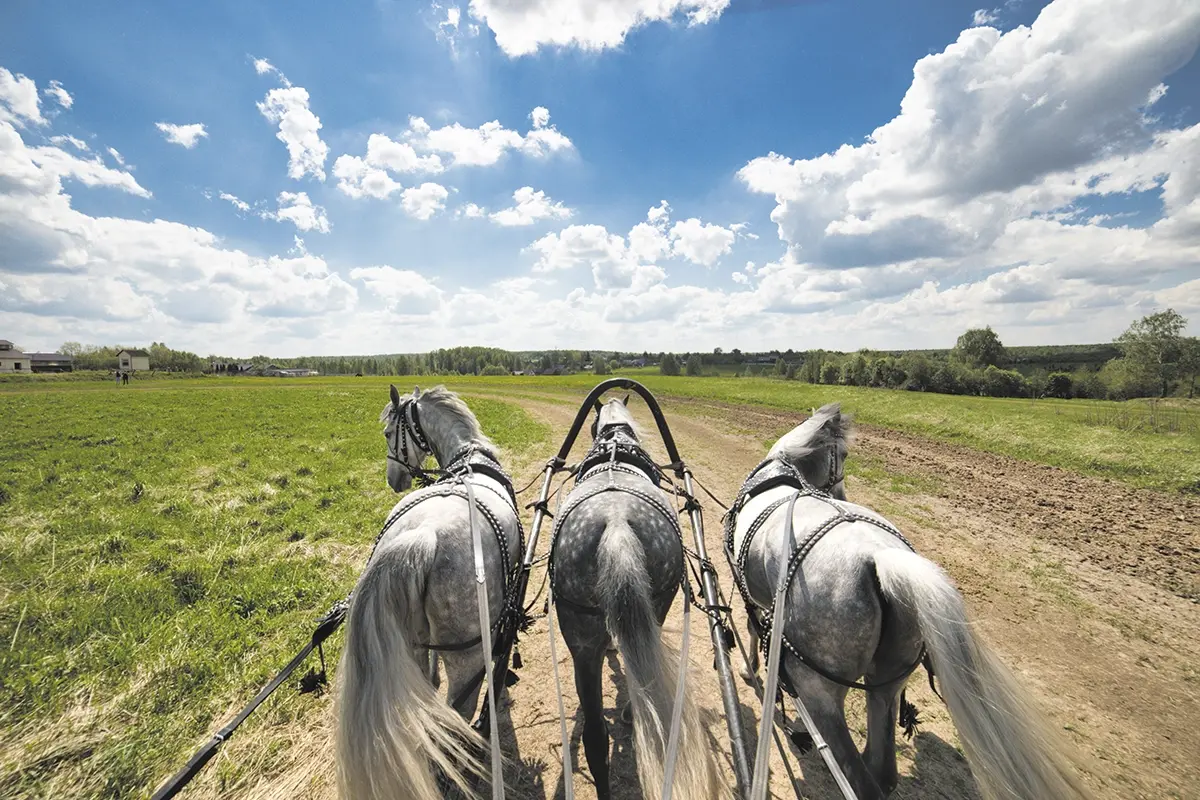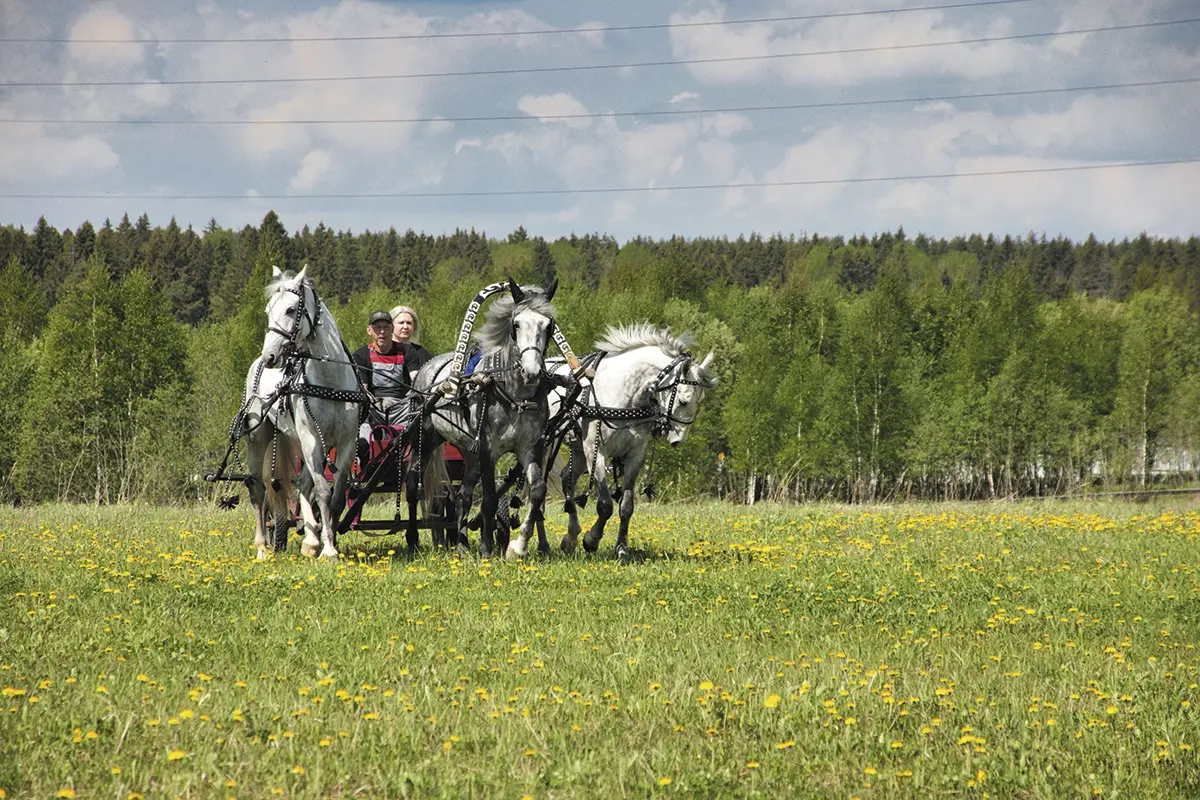
Russia has images that are impossible to mistake for anything else. The Kremlin stars, northern monasteries, the smoke of post houses in winter, the crunch of frosty snow under felt boots. And a troika flying across the snow. Not merely a team of horses but something almost mythological: three horses spread wide beneath the arc of the shaft bow, a bell, white breath over their backs, a sleigh disappearing into the white distance. In Russian culture, the troika has always existed somewhere between reality and legend. It appeared in Gogol and Nekrasov’s works, on artists' canvases, on Christmas cards, in newsreels and pre-revolutionary theatre bills. It was seen as the embodiment of Russia itself — vast, fast-moving, unpredictable.
The fate of the Russian troika turned out to be much the same as that of many old national traditions. After the Revolution, it was first turned into a festive attraction, then dwindled to a rare craft for equestrian enthusiasts. In the 1990s, as stud farms collapsed and racetracks disappeared, it seemed the famous Russian harness might survive only as a museum piece. A few dozen people across the country continued to assemble troikas, preserve old harnessing schools, and search for trotters capable of the 'correct gait'. For most of them, this was neither a business nor even a sport, but an effort to hold on to a vanishing layer of Russian life.
Now the troika is returning in a new status. On 23 January 2026, a commission of Russia’s Ministry of Sport included 'Russian Troika' in the All-Russian Register of Sports as a national sporting discipline. For the first time in decades, the Russian troika has the possibility to exist not as a club curiosity or a festive show, but as a full-fledged sporting discipline — with a federation, regional centres, competitions, a training system, and sports schools. This is a rare story inмcontemporary Russia: a cultural symbol not preserved in a display case but restored to active use.
Since the 1990s, troika racing and the preservation of its traditions werelargely left to a small group of enthusiasts, and organising official competitions at a national level was impossible. Now the plan is to establish an All-Russian Sports Federation, create regional centres, and integrate the discipline into the sports school system.
The first competitions of Russian Troika as a national sport took place on 7−8 February near Vologda — where Troika competitions had been held since 2003. Vologda Oblast is also home to the northernmost stud farm in Russia.
The fate of the Russian troika turned out to be much the same as that of many old national traditions. After the Revolution, it was first turned into a festive attraction, then dwindled to a rare craft for equestrian enthusiasts. In the 1990s, as stud farms collapsed and racetracks disappeared, it seemed the famous Russian harness might survive only as a museum piece. A few dozen people across the country continued to assemble troikas, preserve old harnessing schools, and search for trotters capable of the 'correct gait'. For most of them, this was neither a business nor even a sport, but an effort to hold on to a vanishing layer of Russian life.
Now the troika is returning in a new status. On 23 January 2026, a commission of Russia’s Ministry of Sport included 'Russian Troika' in the All-Russian Register of Sports as a national sporting discipline. For the first time in decades, the Russian troika has the possibility to exist not as a club curiosity or a festive show, but as a full-fledged sporting discipline — with a federation, regional centres, competitions, a training system, and sports schools. This is a rare story inмcontemporary Russia: a cultural symbol not preserved in a display case but restored to active use.
Since the 1990s, troika racing and the preservation of its traditions werelargely left to a small group of enthusiasts, and organising official competitions at a national level was impossible. Now the plan is to establish an All-Russian Sports Federation, create regional centres, and integrate the discipline into the sports school system.
The first competitions of Russian Troika as a national sport took place on 7−8 February near Vologda — where Troika competitions had been held since 2003. Vologda Oblast is also home to the northernmost stud farm in Russia.
‘This is not only a competition — it is part of Russia’s historical code, a tradition with 250 years of history,' observed Russia’s Minister of Sport Mikhail Degtyaryov.
The Russian troika — a symbol of beauty and speed — did indeed occupy a special place in the country’s history. The image of the Troika became embedded for generations in Russian literature, the visual arts, and later in cinema.
By the beginning of the twentieth century, foreigners had come to regard the troika as an almost obligatory element of ‘Russian exotic' — alongside the samovar, furs, and Orthodox domes. European newspapers carried rapturous accounts of the 'wild speed' of Russian equipages, and travellers actively sought the chance to ride through the winter landscape in a troika. For the inhabitants of the Empire, it was a familiar part of everyday life; for Europe, it was an almost theatrical spectacle.
The First Troika
The Russian troika is generally believed to have appeared in the eighteenth century during the reign of Empress Catherine the Great, arising from the need to establish fast new postal routes.
Before the troika, a dispatch to the imperial capital, St Petersburg, could take several weeks or months to arrive. When a fast postal network became necessary, letters and diespatches began to be carried by teams of three horses — swift and enduring.
Most researchers date the earliest mentions of troikas to 16 November 1770, when Colonel A. M. Volkov, head of the Narva postal service, drew up a schedule that referred to postal carriages drawn by three horses.
The postal routes were effectively the bloodstream of the state. Along these routes travelled couriers, officials, military orders, diplomatic correspondence, and treasury funds. The vast territory of the Empire demanded a speed that ordinary harness teams could not deliver. Gradually, this distinctive Russian configuration took shape — not a pair, not a four-in-hand, but a team of three: perfectly suited to long winter roads.
Twice as Fast as Europe
A Russian troika could race across rough terrain at 45−50 km/h — a speed no other harness could match. The secret of its pace and its horses' endurance lay in their particular arrangement: in the centre, the powerful korennik (the shaft horse — the central horse, harnessed between the shafts, who sets the pace at a trot), with the pristyazhnyye (the trace horses — the two outer horses, harnessed by traces and running at a gallop with their heads curved outward) on either side. The effect was that the outer horses seemed to carry the central one. When the coachman pushed the korennik to a gallop, the troika looked like it was lifting off the ground.
Three-horse teams existed in Europe too, but could not reach comparable speeds because they were harnessed in tandem — one behind another. European roads were for the most part well-built but narrow; Russian roads were rutted but wide — and this width allowed horses to run abreast. Beyond that, the troika was in its element in the Russian winter, flying across open spaces, frozen rivers, and steppe.
Nineteenth-century travellers recalled that travelling by Russian troika felt almost frightening. At full speed, the sleigh skidded across the frozen crust of snow, the trace horses ran wide apart, and the coachman — the yamshchik (the professional postal coachman, whose skills were legendary) — practically stood on the box, controlling the team with voice and reins alone. Driving a troika demanded a mastery of its own: it was not enough simply to hold the speed — you had to feel the temperament of each horse and maintain a common rhythm. Good yamshchiki were known by name.
The Flashing Lights of the Eighteenth Century
At first, sleigh bells were permitted only on postal and courier troikas. Their sound carried for two versts (just over two kilometres), which mattered greatly for fast-moving teams on roads with no traffic regulation. On hearing the bells, postal workers were required to have a fresh team ready so as not to delay an urgent dispatch.
From the chapter 'Along the Petersburg Road' in Vladimir Gilyarovsky’s Moscow and Muscovites: 'But now a courier’s bell begins to ring out along the Petersburg road — and everything comes to life. The right side of the road is cleared, and a courier or state-messenger troika hurtles past at a furious pace.'
In time bells were no longer the preserve of postal coachmen. Their sound was regarded as a charm against evil spirits, and the tradition of newlyweds riding in a troika with jingling bells became a standard wedding custom.
Soon Soon the bells became a craft in their own right. They were cast in Valdai, Purekh, and Kasimov. The finest examples bore inscriptions: 'Gift of Valdai', 'Ring out, console, travel on in haste.' Every craftsman aimed for a particular timbre — deep and resonant, or, conversely, high and sharp. On the Russian road, sound was almost as important an element of the troika as the horses themselves.
The Russian troika — a symbol of beauty and speed — did indeed occupy a special place in the country’s history. The image of the Troika became embedded for generations in Russian literature, the visual arts, and later in cinema.
By the beginning of the twentieth century, foreigners had come to regard the troika as an almost obligatory element of ‘Russian exotic' — alongside the samovar, furs, and Orthodox domes. European newspapers carried rapturous accounts of the 'wild speed' of Russian equipages, and travellers actively sought the chance to ride through the winter landscape in a troika. For the inhabitants of the Empire, it was a familiar part of everyday life; for Europe, it was an almost theatrical spectacle.
The First Troika
The Russian troika is generally believed to have appeared in the eighteenth century during the reign of Empress Catherine the Great, arising from the need to establish fast new postal routes.
Before the troika, a dispatch to the imperial capital, St Petersburg, could take several weeks or months to arrive. When a fast postal network became necessary, letters and diespatches began to be carried by teams of three horses — swift and enduring.
Most researchers date the earliest mentions of troikas to 16 November 1770, when Colonel A. M. Volkov, head of the Narva postal service, drew up a schedule that referred to postal carriages drawn by three horses.
The postal routes were effectively the bloodstream of the state. Along these routes travelled couriers, officials, military orders, diplomatic correspondence, and treasury funds. The vast territory of the Empire demanded a speed that ordinary harness teams could not deliver. Gradually, this distinctive Russian configuration took shape — not a pair, not a four-in-hand, but a team of three: perfectly suited to long winter roads.
Twice as Fast as Europe
A Russian troika could race across rough terrain at 45−50 km/h — a speed no other harness could match. The secret of its pace and its horses' endurance lay in their particular arrangement: in the centre, the powerful korennik (the shaft horse — the central horse, harnessed between the shafts, who sets the pace at a trot), with the pristyazhnyye (the trace horses — the two outer horses, harnessed by traces and running at a gallop with their heads curved outward) on either side. The effect was that the outer horses seemed to carry the central one. When the coachman pushed the korennik to a gallop, the troika looked like it was lifting off the ground.
Three-horse teams existed in Europe too, but could not reach comparable speeds because they were harnessed in tandem — one behind another. European roads were for the most part well-built but narrow; Russian roads were rutted but wide — and this width allowed horses to run abreast. Beyond that, the troika was in its element in the Russian winter, flying across open spaces, frozen rivers, and steppe.
Nineteenth-century travellers recalled that travelling by Russian troika felt almost frightening. At full speed, the sleigh skidded across the frozen crust of snow, the trace horses ran wide apart, and the coachman — the yamshchik (the professional postal coachman, whose skills were legendary) — practically stood on the box, controlling the team with voice and reins alone. Driving a troika demanded a mastery of its own: it was not enough simply to hold the speed — you had to feel the temperament of each horse and maintain a common rhythm. Good yamshchiki were known by name.
The Flashing Lights of the Eighteenth Century
At first, sleigh bells were permitted only on postal and courier troikas. Their sound carried for two versts (just over two kilometres), which mattered greatly for fast-moving teams on roads with no traffic regulation. On hearing the bells, postal workers were required to have a fresh team ready so as not to delay an urgent dispatch.
From the chapter 'Along the Petersburg Road' in Vladimir Gilyarovsky’s Moscow and Muscovites: 'But now a courier’s bell begins to ring out along the Petersburg road — and everything comes to life. The right side of the road is cleared, and a courier or state-messenger troika hurtles past at a furious pace.'
In time bells were no longer the preserve of postal coachmen. Their sound was regarded as a charm against evil spirits, and the tradition of newlyweds riding in a troika with jingling bells became a standard wedding custom.
Soon Soon the bells became a craft in their own right. They were cast in Valdai, Purekh, and Kasimov. The finest examples bore inscriptions: 'Gift of Valdai', 'Ring out, console, travel on in haste.' Every craftsman aimed for a particular timbre — deep and resonant, or, conversely, high and sharp. On the Russian road, sound was almost as important an element of the troika as the horses themselves.
Selecting the Trotters
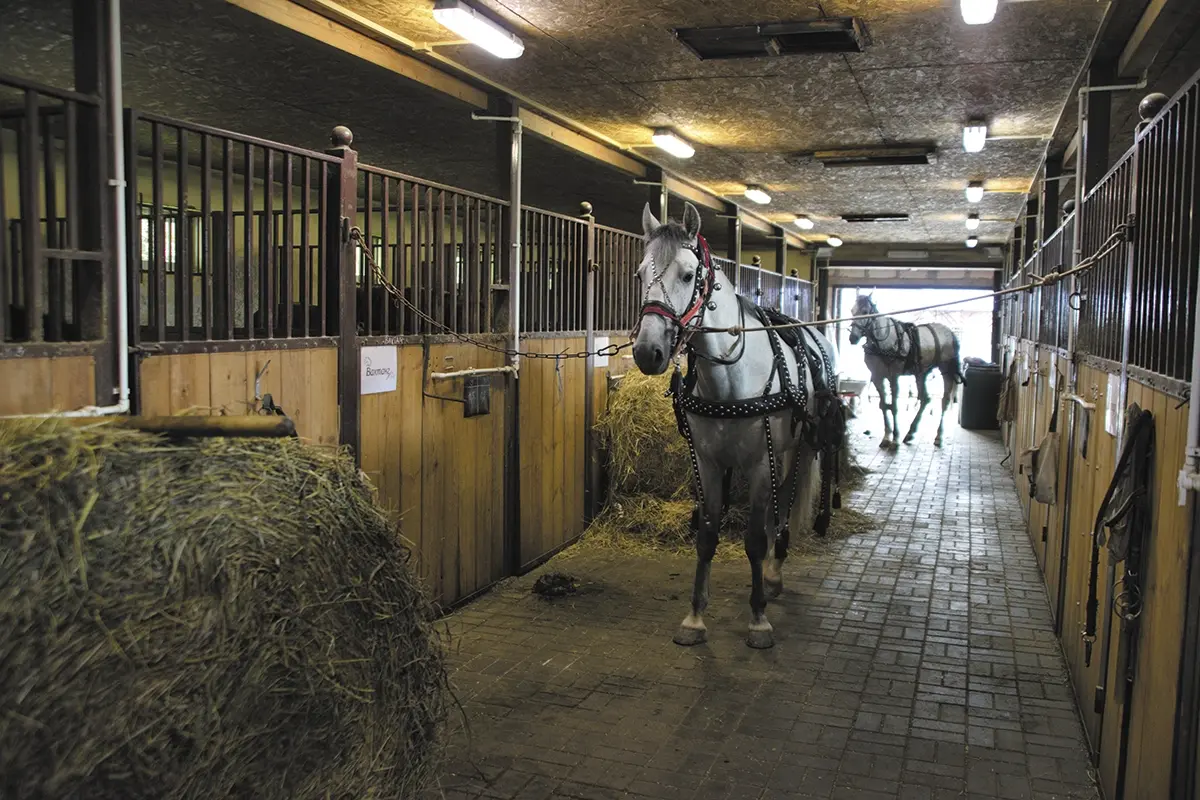
The finest Russian troikas were considered to be those with colour-matched trotters. The korennik was always required to be considerably larger than the trace horses. The most popular breed was the Vyatka trotter (the Vyatka — an ancient Russian light horse breed developed in the Vyatka and Kama river basins, known for its hardiness and endurance) — compact but remarkably tough. The most prestigious and expensive troika was one composed of Orlov trotters.
Before the breed was created by the Count, shaft horses in particular had to be selected individually for their trotting ability. Orlov-Chesmensky developed a breed that passed this trotting ability down genetically.
For a true troika, speed and power were not the only requirements. The horses had to form a unified ensemble. Coat colour, height, and character of movement were all matched. Grey Orlovs were particularly prized — striking, visible at a distance, and especially striking against the snow. Wealthy owners could spend years assembling the perfect troika, changing the trace horses and seeking a new shaft horse.
The Orlov Trotters
In 1775, Count Alexei Orlov-Chesmensky (the Russian naval commander who destroyed the Ottoman fleet at the Battle of Chesma in 1770) acquired horses in the Morea (the Peloponnese peninsula in Greece, then under Ottoman control) for Catherine II. Several of those — among them the Arabian stallion Smetanka, which cost the enormous sum of 60,000 roubles in banknotes — the Count kept for himself.
It is said that the purchase and transportation of the horses was assisted by Pasha Hassan Bey, who had commanded the defeated Turkish fleet. The Count had taken Hassan Bey’s family prisoner and subsequently returned them to their homeland.
All the horses except Smetanka were sent by sea. The progenitor of the Orlov Trotter breed had to be transported overland across the Balkans with an entire escort, and for concealment the white horse was daubed with black paint.
Smetanka lived in Russia for less than a year, but left offspring from which the entire history of the Orlov Trotter descends. Later, at the Khrenovskoy Stud Farm (Khrenovskoy Konnyi Zavod — the celebrated stud farm in Voronezh Oblast, established by Orlov and still one of Russia’s principal breeding centres), Orlov-Chesmensky created what was effectively Russia’s first systematic selective breeding programme for sport horses. The Orlov proved close to ideal for the troika: powerful, beautiful, enduring, and capable of sustaining a high pace over long distances.
Recognition and the Industrial Revolution
In the second half of the nineteenth century, the industrial revolution — steam locomotives, and then the motor car — sent the troika’s popularity into decline. Although dispatches of state importance were no longer carried by troika, the team found a new life in entertainment: people rode troikas during holidays and at Maslenitsa (Shrovetide — the pre-Lent festival of revelry and farewell to winter, one of the most exuberant celebrations in the Russian calendar).
Troika racing, which first became popular at the Moscow Hippodrome starting from the 1840s, spread across Russia. Almost every coachman tried to make his team unlike any other.
By the turn of the twentieth century, the troika had become a defining symbol of festive Russia. It appeared on boxes of sweets, theatre bills, and Christmas cards. Major cities acquired specially kept 'display' troikas for the promenades and rides of the nobility. For prosperous merchants and industrialists, keeping one’s own troika was a matter of prestige.
The French journalist Louis Teste, who was in Moscow during the coronation of Alexander III in 1883, described une troïka as follows: 'A very beautiful harness, specifically Russian: three horses harnessed to a small cart, with each of the three running at a different gait.'
In 1911, the Russian troika received international recognition when it was seen in Europe for the first time — at the World Exhibition in London. The korennik was the celebrated Orlov trotter Ratnik Turetsky, winner of the Imperial Prize.
A Gift from Nikita Khrushchev
In 1954, for the reopening of VDNKh (the All-Union Exhibition of Achievements of the National Economy — the famous exhibition ground in Moscow, opened in 1939 and redesigned after the war as a showcase of Soviet accomplishment) after reconstruction, the Soviet leadership instructed stud farms to prepare Russian troikas. The task was accomplished by specialists from Vladimir, Kazan, and Vologda. In time, winter and Maslenitsa rides across the exhibition grounds became a tradition.
In the 1970s and 1980s, troikas were used to entertain guests at the Russkaya Zima ('Russian Winter') festival. Races were also held, and winners received trophies.
Russian troikas continued to make an impression abroad. In 1982, a troika from Moscow Stud Farm No. 1, with the Orlov trotter Pyostry Palas as korennik, received the gold at the international Equitana exhibition and trade fair in Essen. Seven years later, at the same venue, another Russian troika triumphed: with the Orlov Vals in the centre, flanked by Tsegel and Tsiemir as trace horses.
Throughout the twentieth century, Russian troikas remained a coveted gift for high-ranking foreign visitors. In 1959, Nikita Khrushchev presented a troika to the American industrialist Cyrus Eaton (the Cleveland-based financier and philanthropist who became known for his efforts to promote dialogue between the United States and the Soviet Union during the Cold War).
The gifted troika was composed of Orlov trotters: the korennik Naturchik and two trace horses, Otklik and Konus. The horses were run in at the Tambov State Stables and then at the Moscow Hippodrome.
Pravda newspaper reported: 'On Sunday 18 January, despite the cold weather, around 15,000 residents of Cleveland gathered at the racecourse to see the only troika in the United States.' The first to ride around the track were Eaton himself and President Roosevelt’s son.
When a Symbol Leaves the Museum Case and Returns to the Open Road
Today the Russian troika is embarking on what is perhaps the most unexpected chapter of its history. After centuries on the postal tracts, after tsarist outings, fairs, racetracks, Soviet celebrations, and near-disappearance in the 1990s, it now returns as part of twenty-first-century life — as an officially recognised sporting discipline. And there is an important shift in this. Previously, the troika existed above all as a beautiful historical image. Now it must become, once again, a living craft — one that requires people, schools, horse breeding, trained drivers, and daily practice
To achieve this, an entire ecosystem will need to be rebuilt practically from scratch. The Russian troika is one of the most demanding forms of equestrian art. Breeding a fine trotter is not enough: you need masters of harnessing, blacksmiths, saddlers (shorniki — harness-makers, who craft the complex leather equipment of the troika), trainers who understand a three-horse team and not just a single horse, racetracks and winter circuits. You need people capable of transmitting rare knowledge that for decades survived almost underground, passed from one horseman to another. And perhaps it is precisely this that makes the present revival especially valuable: the task is not to reconstruct a beautiful past, but to return a complex living tradition while it can still be saved.
The Russian troika was always more than transportation or sport. It brought together much of what Russia loves to tell about itself: speed, vastness, risk, the beauty of winter, boldness, and the capacity to press forward in defiance. There is a reason Gogol compared the country itself to a flying troika, watched by the whole world in wonder. (The famous closing image of Dead Souls, 1842: ‘And, Russia, art not thou too flying onwards like a spirited troika that nothing can overtake?; as translated by Constance Garnett)
The finest Russian troikas were considered to be those with colour-matched trotters. The korennik was always required to be considerably larger than the trace horses. The most popular breed was the Vyatka trotter (the Vyatka — an ancient Russian light horse breed developed in the Vyatka and Kama river basins, known for its hardiness and endurance) — compact but remarkably tough. The most prestigious and expensive troika was one composed of Orlov trotters.
Before the breed was created by the Count, shaft horses in particular had to be selected individually for their trotting ability. Orlov-Chesmensky developed a breed that passed this trotting ability down genetically.
For a true troika, speed and power were not the only requirements. The horses had to form a unified ensemble. Coat colour, height, and character of movement were all matched. Grey Orlovs were particularly prized — striking, visible at a distance, and especially striking against the snow. Wealthy owners could spend years assembling the perfect troika, changing the trace horses and seeking a new shaft horse.
The Orlov Trotters
In 1775, Count Alexei Orlov-Chesmensky (the Russian naval commander who destroyed the Ottoman fleet at the Battle of Chesma in 1770) acquired horses in the Morea (the Peloponnese peninsula in Greece, then under Ottoman control) for Catherine II. Several of those — among them the Arabian stallion Smetanka, which cost the enormous sum of 60,000 roubles in banknotes — the Count kept for himself.
It is said that the purchase and transportation of the horses was assisted by Pasha Hassan Bey, who had commanded the defeated Turkish fleet. The Count had taken Hassan Bey’s family prisoner and subsequently returned them to their homeland.
All the horses except Smetanka were sent by sea. The progenitor of the Orlov Trotter breed had to be transported overland across the Balkans with an entire escort, and for concealment the white horse was daubed with black paint.
Smetanka lived in Russia for less than a year, but left offspring from which the entire history of the Orlov Trotter descends. Later, at the Khrenovskoy Stud Farm (Khrenovskoy Konnyi Zavod — the celebrated stud farm in Voronezh Oblast, established by Orlov and still one of Russia’s principal breeding centres), Orlov-Chesmensky created what was effectively Russia’s first systematic selective breeding programme for sport horses. The Orlov proved close to ideal for the troika: powerful, beautiful, enduring, and capable of sustaining a high pace over long distances.
Recognition and the Industrial Revolution
In the second half of the nineteenth century, the industrial revolution — steam locomotives, and then the motor car — sent the troika’s popularity into decline. Although dispatches of state importance were no longer carried by troika, the team found a new life in entertainment: people rode troikas during holidays and at Maslenitsa (Shrovetide — the pre-Lent festival of revelry and farewell to winter, one of the most exuberant celebrations in the Russian calendar).
Troika racing, which first became popular at the Moscow Hippodrome starting from the 1840s, spread across Russia. Almost every coachman tried to make his team unlike any other.
By the turn of the twentieth century, the troika had become a defining symbol of festive Russia. It appeared on boxes of sweets, theatre bills, and Christmas cards. Major cities acquired specially kept 'display' troikas for the promenades and rides of the nobility. For prosperous merchants and industrialists, keeping one’s own troika was a matter of prestige.
The French journalist Louis Teste, who was in Moscow during the coronation of Alexander III in 1883, described une troïka as follows: 'A very beautiful harness, specifically Russian: three horses harnessed to a small cart, with each of the three running at a different gait.'
In 1911, the Russian troika received international recognition when it was seen in Europe for the first time — at the World Exhibition in London. The korennik was the celebrated Orlov trotter Ratnik Turetsky, winner of the Imperial Prize.
A Gift from Nikita Khrushchev
In 1954, for the reopening of VDNKh (the All-Union Exhibition of Achievements of the National Economy — the famous exhibition ground in Moscow, opened in 1939 and redesigned after the war as a showcase of Soviet accomplishment) after reconstruction, the Soviet leadership instructed stud farms to prepare Russian troikas. The task was accomplished by specialists from Vladimir, Kazan, and Vologda. In time, winter and Maslenitsa rides across the exhibition grounds became a tradition.
In the 1970s and 1980s, troikas were used to entertain guests at the Russkaya Zima ('Russian Winter') festival. Races were also held, and winners received trophies.
Russian troikas continued to make an impression abroad. In 1982, a troika from Moscow Stud Farm No. 1, with the Orlov trotter Pyostry Palas as korennik, received the gold at the international Equitana exhibition and trade fair in Essen. Seven years later, at the same venue, another Russian troika triumphed: with the Orlov Vals in the centre, flanked by Tsegel and Tsiemir as trace horses.
Throughout the twentieth century, Russian troikas remained a coveted gift for high-ranking foreign visitors. In 1959, Nikita Khrushchev presented a troika to the American industrialist Cyrus Eaton (the Cleveland-based financier and philanthropist who became known for his efforts to promote dialogue between the United States and the Soviet Union during the Cold War).
The gifted troika was composed of Orlov trotters: the korennik Naturchik and two trace horses, Otklik and Konus. The horses were run in at the Tambov State Stables and then at the Moscow Hippodrome.
Pravda newspaper reported: 'On Sunday 18 January, despite the cold weather, around 15,000 residents of Cleveland gathered at the racecourse to see the only troika in the United States.' The first to ride around the track were Eaton himself and President Roosevelt’s son.
When a Symbol Leaves the Museum Case and Returns to the Open Road
Today the Russian troika is embarking on what is perhaps the most unexpected chapter of its history. After centuries on the postal tracts, after tsarist outings, fairs, racetracks, Soviet celebrations, and near-disappearance in the 1990s, it now returns as part of twenty-first-century life — as an officially recognised sporting discipline. And there is an important shift in this. Previously, the troika existed above all as a beautiful historical image. Now it must become, once again, a living craft — one that requires people, schools, horse breeding, trained drivers, and daily practice
To achieve this, an entire ecosystem will need to be rebuilt practically from scratch. The Russian troika is one of the most demanding forms of equestrian art. Breeding a fine trotter is not enough: you need masters of harnessing, blacksmiths, saddlers (shorniki — harness-makers, who craft the complex leather equipment of the troika), trainers who understand a three-horse team and not just a single horse, racetracks and winter circuits. You need people capable of transmitting rare knowledge that for decades survived almost underground, passed from one horseman to another. And perhaps it is precisely this that makes the present revival especially valuable: the task is not to reconstruct a beautiful past, but to return a complex living tradition while it can still be saved.
The Russian troika was always more than transportation or sport. It brought together much of what Russia loves to tell about itself: speed, vastness, risk, the beauty of winter, boldness, and the capacity to press forward in defiance. There is a reason Gogol compared the country itself to a flying troika, watched by the whole world in wonder. (The famous closing image of Dead Souls, 1842: ‘And, Russia, art not thou too flying onwards like a spirited troika that nothing can overtake?; as translated by Constance Garnett)