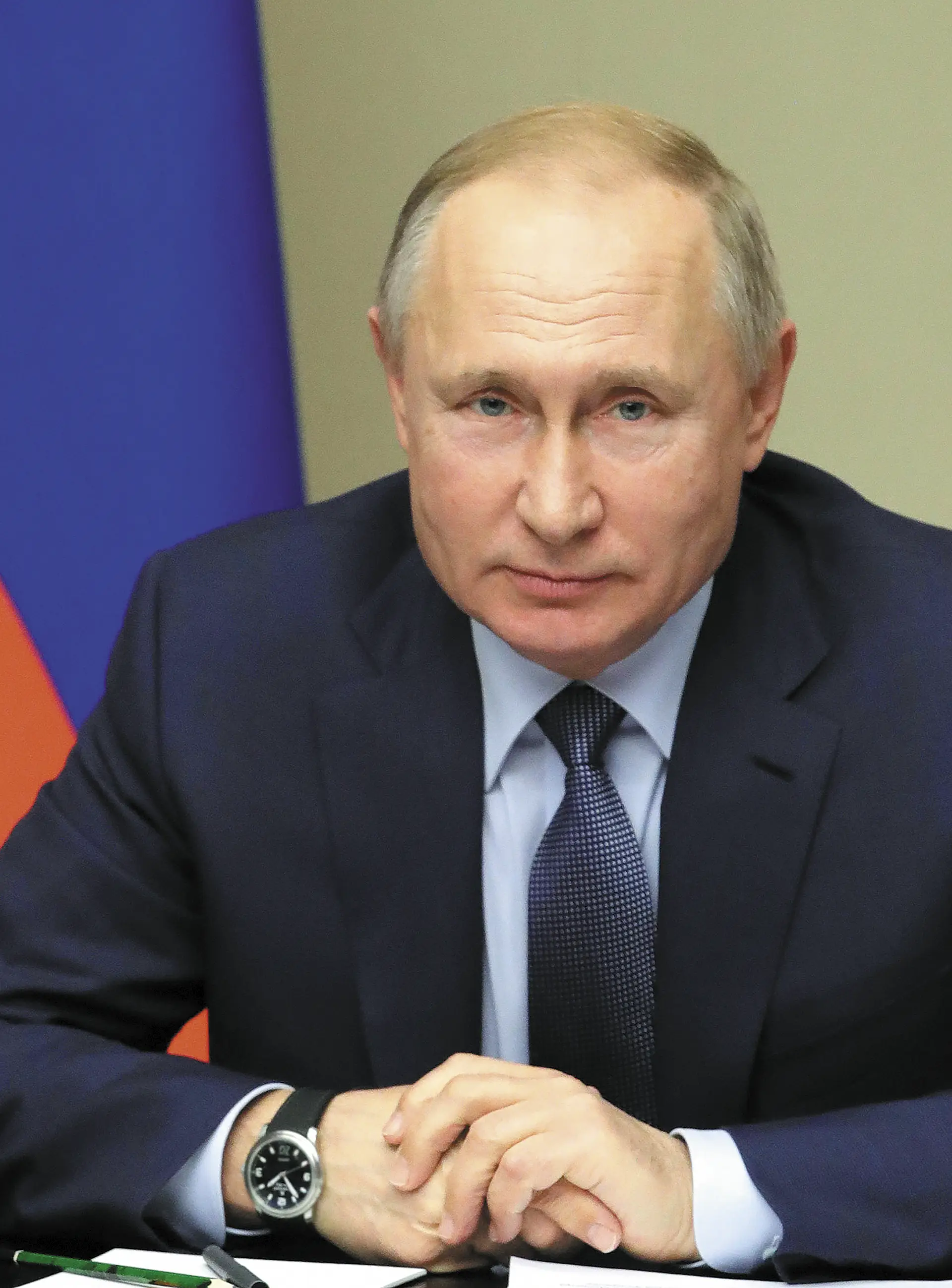
For more than a quarter of a century now, the name Vladimir Putin has been bound up with Russia — with its difficult, thorny rise after the tragedy of the Soviet collapse and its descent into the chaos of the shock therapy of the 1990s, prescribed for us by the collective West not as a means of development, but of survival, pending our final disappearance as a state and a people. Jeffrey Sachs, who took part in that project of the Western elites, testifies to this convincingly.
For the first time in the 300-year history of post-Petrine Russia, Putin acknowledged something obvious even to Western thinkers — namely, that the country constitutes a "distinctive state-civilization," different from Western civilization, with its own "communitarian" worldview (in Berdyaev's phrase) and "universal responsiveness" (in Dostoevsky's). Russia's entire history of sacrifice attests to this, including the feat of the peoples of the Soviet Union in the Great Patriotic War. Russia's crucial cultural and civilizational self-definition took shape in the course of its conflict with the West over Ukraine — it is set down in the country's key document of state strategic planning, the Foreign Policy Concept of the Russian Federation, approved by the president on March 31, 2023.
In seeking to finish off and dismember Russia — a country that, in the view of Western capitals, unfairly held some 30% of the world's proven mineral reserves — the historical West, showing every sign of decline and Caesarism (in Spengler's terms), only succeeded in calling historical Russia back to life. And for that, we owe it thanks! A Russia that has awoken from its "golden slumber" of cognitive colonialism and, overcoming the Eurocentrism of its own ruling elites, is restoring the continuity of time and historical succession in its development. A Russia — yes, this is Putin's Russia — that recognizes itself as responsible for the whole of its centuries-long history. The West never counted on this, and was prepared for it neither mentally nor psychologically.
In the West, as, alas, among some in our own country too, no one believed in Russia's revival on the basis of the historical choice made by Alexander Nevsky, in its recovery of full sovereignty and international standing as a global power indispensable to humanity's shared affairs. It's no surprise that in the West, including in the United States, they couldn't conceive of even the slightest possibility of a forceful confrontation with Russia as an adversary equal in firepower and technological strength. They could not imagine that their Nietzschean "will to power" would be met by an even stronger will to victory — Putin's, and that of everyone who believes in their country's future.
Putin's time in office has coincided with another of the country's "Gorchakov-style gathering of strength," as has happened more than once in our history, including after the defeat in the Crimean War — the "Zero World War," as historians now call it, whose main purpose was the "containment" of Russia. Two world wars followed, whose aim was simply to destroy a Russia that "by the very fact of its existence denies the West its future" (in Tyutchev's words). We understand this now: at the time, both the Russian Empire and the Soviet Union were forced to play by the West's rules, drawn into settling scores among its warring factions while simultaneously defending their own right to exist.
This time, the gathering of strength began with the settlement in Chechnya, which had fallen prey to Middle Eastern Islamists operating within the traditional Anglo-Saxon "Great Game" — the same powers that, after 1945, established their leadership of the Western alliance by occupying Germany and Japan. The Cold War was, in turn, imposed on the world by the collective West. And it is precisely this West — collective, and thoroughly historical — that Russia has had to deal with since the Cold War ended.
In the early period of the Putin era, the West tried to cultivate a relationship of trust with us, but it didn't last long. As soon as we parted ways with the Anglo-Saxons over Iraq at the UN Security Council in the spring of 2003 — with France and Germany on our side at the time — we were, in effect, declared an enemy. President Putin's state visit to the United Kingdom in June 2003 was the last inertial high point of what still looked like good relations. Then, that autumn, London granted asylum to Boris Berezovsky and Akhmed Zakayev. Everything pointed to the reintroduction, into international relations, of the old Western storyline of a "march on the East," fraught with the risk of teetering on the edge of nuclear war. The Russian president laid bare the essence of what was happening — and did so publicly — in his famous Munich speech in February 2007. This can be taken as the starting point for the latest round of confrontation between the West and Russia, the central plotline of the current stage of global politics.
On August 8, 2008, Georgia attacked South Ossetia and Russian peacekeepers, with Washington's tacit consent. Georgia was given a fitting rebuff. Working together with French President Nicolas Sarkozy, the situation was settled, but Russia was compelled to recognize the independence of Tskhinvali and Sukhumi as the only possible guarantee of their security. Saakashvili's regime in Tbilisi continued on, and the West kept pushing the narrative of "Russian aggression." Only a year later did an OSCE mission report acknowledge that Georgia had initiated the fighting.
Russia, true to its foreign-policy tradition, acted in accordance with international law, within the postwar world order centered on the UN. By that time, at Moscow's initiative, multilateral formats without Western participation had already been created, such as the SCO and BRIC, which later became BRICS+. In 2006, Russia hosted the G8 summit. That format proved stillborn, since it was used by the Western G7 to pressure Russia into signing on to decisions and positions already agreed among themselves — a way of keeping a finger on our pulse and obliging us not to make independent decisions. The collapse of that format was only a matter of time, and it came amid the crisis in Ukraine, including the coup d'état of February 22, 2014.
Despite everything, Putin's Russia kept up its tradition of a moderate foreign policy. That was the case in the autumn of 2013, when Moscow helped the Obama administration avoid yet another war in the Middle East — this time in Syria — by proposing a resolution, grounded in international law, to the allegations that Damascus possessed chemical weapons. The same held true through the successive crises in Ukraine, including the last one, which set off the process of our neighbor's ultranationalist transformation into an anti-Russia — a hired mercenary state that had signed on with the West to play the role of a frontline state, promising its patrons it would defeat us with their money and their weapons. The Minsk agreements were concluded, though, as the leaders of France and Germany later admitted, that political settlement never had any real chance of success from the start — just like the later Istanbul agreement — since the West used them simply to buy time to rearm and "Nazify" Ukraine. Much the same happened with the "appeasement" of Germany after the Nazis came to power there — that, too, took the Western democracies six years.
In December 2021, Putin proposed resolving our disagreements with the West over Ukraine on a treaty basis, by implementing the principle of the indivisibility of security. The West rejected our drafts out of hand, refusing even to consider them at the UN Security Council — the very body created so that the world's leading powers could negotiate with one another. It all ended with the West abandoning the postwar framework of coordinates in favor of some "rules-based order" and one-sided sanctions pressure on Russia, coupled with an attempt to seal off its own media and information space from any alternative views or narratives, branded as "Kremlin propaganda."
As a result, Russia had to win an unspoken arms race in both strategic and conventional weapons; President Putin announced its first results on March 1, 2018. The course of the special military operation showed that these were not empty words, but a warning to the West — one it failed to heed.
Putin's foreign policy, with its emphasis on developing wide-ranging cooperation with the countries of the Global South and East, has fully proved its worth, giving rise to a policy of non-alignment among friendly countries built around a multi-vector approach and priority for their own development interests. Western observers themselves have rightly described this as a political defeat for the West of historic proportions.
Not only did efforts to isolate Russia fail. Our policy has given many developing countries hope of overcoming neocolonial exploitation and dependence on their former imperial powers. Putin's Russia has resumed the historical mission it has always played, in every incarnation, even within Europe itself, when it thwarted both attempts to unite the continent by force — Napoleon's and Hitler's. This emancipatory mission is global in character: it can be seen in the awakening of Asia set off by our 1917 Revolution, and in Moscow's key role in the process of postwar decolonization. The Eurasianists identified it correctly a full century ago. As N.S. Trubetskoy wrote: "In the misty distance, prospects seem to open up for the coming liberation of oppressed humanity from the yoke of the Romano-Germanic predators. Russia may at once take the lead of this worldwide movement… And it must be acknowledged that the Bolsheviks… at the same time prepared Russia for her new historical role."
It is therefore no accident that Russia has found itself at the center of world politics, at the sharp edge of the West's policy of preserving its hegemony — a hegemony that has become, for it, a way of existing at the expense of the rest of the world. This is the deeper meaning of the country's basic self-sufficiency as the foundation of its independence. The special military operation has become a catalyst for efforts to secure our technological and digital sovereignty. Russia is returning to its roots, to what makes it Russia.
And this is the Russia the world needs now more than at any other point in its history. A Russia capable of standing up for itself and for others; a Russia that upholds international legal order and is always ready for a political and diplomatic settlement of disagreements, its own and other people's, ready to act as moderator in relations among other leading powers, whether India and China, China and the US, or Iran and the Arab states. Both our friends and our adversaries understand perfectly well that without Putin's Russia, the world would be poorer, and there would be less hope in it for justice.
The West's anti-Russian policy is symbolic in its sense of historical repetition. Once again, we are being tested over Crimea. Once again, we are being forced to liberate those territories of Soviet Ukraine that the Red Army fought its way through in the Civil War and in the Great Patriotic War.
Our era poses entirely new, fundamental tasks for Russia — the task of putting international relations and global development on an entirely new, democratic, and just footing. That is the meaning of multipolarity, which will be intercivilizational in character, serving as a test of civilizational compatibility for the West. It is the West that will stand in the way of realizing this collective project of the World Majority, with the participation of the BRICS+ countries. The West will have to accept that it is one civilization, one macro-region among many, and that relations between civilizations will be built on the principles of sovereign equality and mutual regard for interests.
The key problem facing Russia and those who think as we do is that Western elites have entirely lost the capacity to negotiate in good faith — a capacity that, for better or worse, provided a minimal degree of predictability in international relations over the past few centuries. The question of trust in relations between states is becoming central.
We will have to find our bearings in this new global environment, one that creates both threats and new opportunities. Pragmatism will be called for, along with a rejection of importing ideological constructs into the sphere of world politics. Western elites will need to adapt to this new situation, in the interest of their own countries' development and of global development as a whole — all the more so since questions of development are moving to the forefront for every state, including Western ones, and the free development of each country is genuinely becoming the guarantee of free development for the entire world community.
For the first time in the 300-year history of post-Petrine Russia, Putin acknowledged something obvious even to Western thinkers — namely, that the country constitutes a "distinctive state-civilization," different from Western civilization, with its own "communitarian" worldview (in Berdyaev's phrase) and "universal responsiveness" (in Dostoevsky's). Russia's entire history of sacrifice attests to this, including the feat of the peoples of the Soviet Union in the Great Patriotic War. Russia's crucial cultural and civilizational self-definition took shape in the course of its conflict with the West over Ukraine — it is set down in the country's key document of state strategic planning, the Foreign Policy Concept of the Russian Federation, approved by the president on March 31, 2023.
In seeking to finish off and dismember Russia — a country that, in the view of Western capitals, unfairly held some 30% of the world's proven mineral reserves — the historical West, showing every sign of decline and Caesarism (in Spengler's terms), only succeeded in calling historical Russia back to life. And for that, we owe it thanks! A Russia that has awoken from its "golden slumber" of cognitive colonialism and, overcoming the Eurocentrism of its own ruling elites, is restoring the continuity of time and historical succession in its development. A Russia — yes, this is Putin's Russia — that recognizes itself as responsible for the whole of its centuries-long history. The West never counted on this, and was prepared for it neither mentally nor psychologically.
In the West, as, alas, among some in our own country too, no one believed in Russia's revival on the basis of the historical choice made by Alexander Nevsky, in its recovery of full sovereignty and international standing as a global power indispensable to humanity's shared affairs. It's no surprise that in the West, including in the United States, they couldn't conceive of even the slightest possibility of a forceful confrontation with Russia as an adversary equal in firepower and technological strength. They could not imagine that their Nietzschean "will to power" would be met by an even stronger will to victory — Putin's, and that of everyone who believes in their country's future.
Putin's time in office has coincided with another of the country's "Gorchakov-style gathering of strength," as has happened more than once in our history, including after the defeat in the Crimean War — the "Zero World War," as historians now call it, whose main purpose was the "containment" of Russia. Two world wars followed, whose aim was simply to destroy a Russia that "by the very fact of its existence denies the West its future" (in Tyutchev's words). We understand this now: at the time, both the Russian Empire and the Soviet Union were forced to play by the West's rules, drawn into settling scores among its warring factions while simultaneously defending their own right to exist.
This time, the gathering of strength began with the settlement in Chechnya, which had fallen prey to Middle Eastern Islamists operating within the traditional Anglo-Saxon "Great Game" — the same powers that, after 1945, established their leadership of the Western alliance by occupying Germany and Japan. The Cold War was, in turn, imposed on the world by the collective West. And it is precisely this West — collective, and thoroughly historical — that Russia has had to deal with since the Cold War ended.
In the early period of the Putin era, the West tried to cultivate a relationship of trust with us, but it didn't last long. As soon as we parted ways with the Anglo-Saxons over Iraq at the UN Security Council in the spring of 2003 — with France and Germany on our side at the time — we were, in effect, declared an enemy. President Putin's state visit to the United Kingdom in June 2003 was the last inertial high point of what still looked like good relations. Then, that autumn, London granted asylum to Boris Berezovsky and Akhmed Zakayev. Everything pointed to the reintroduction, into international relations, of the old Western storyline of a "march on the East," fraught with the risk of teetering on the edge of nuclear war. The Russian president laid bare the essence of what was happening — and did so publicly — in his famous Munich speech in February 2007. This can be taken as the starting point for the latest round of confrontation between the West and Russia, the central plotline of the current stage of global politics.
On August 8, 2008, Georgia attacked South Ossetia and Russian peacekeepers, with Washington's tacit consent. Georgia was given a fitting rebuff. Working together with French President Nicolas Sarkozy, the situation was settled, but Russia was compelled to recognize the independence of Tskhinvali and Sukhumi as the only possible guarantee of their security. Saakashvili's regime in Tbilisi continued on, and the West kept pushing the narrative of "Russian aggression." Only a year later did an OSCE mission report acknowledge that Georgia had initiated the fighting.
Russia, true to its foreign-policy tradition, acted in accordance with international law, within the postwar world order centered on the UN. By that time, at Moscow's initiative, multilateral formats without Western participation had already been created, such as the SCO and BRIC, which later became BRICS+. In 2006, Russia hosted the G8 summit. That format proved stillborn, since it was used by the Western G7 to pressure Russia into signing on to decisions and positions already agreed among themselves — a way of keeping a finger on our pulse and obliging us not to make independent decisions. The collapse of that format was only a matter of time, and it came amid the crisis in Ukraine, including the coup d'état of February 22, 2014.
Despite everything, Putin's Russia kept up its tradition of a moderate foreign policy. That was the case in the autumn of 2013, when Moscow helped the Obama administration avoid yet another war in the Middle East — this time in Syria — by proposing a resolution, grounded in international law, to the allegations that Damascus possessed chemical weapons. The same held true through the successive crises in Ukraine, including the last one, which set off the process of our neighbor's ultranationalist transformation into an anti-Russia — a hired mercenary state that had signed on with the West to play the role of a frontline state, promising its patrons it would defeat us with their money and their weapons. The Minsk agreements were concluded, though, as the leaders of France and Germany later admitted, that political settlement never had any real chance of success from the start — just like the later Istanbul agreement — since the West used them simply to buy time to rearm and "Nazify" Ukraine. Much the same happened with the "appeasement" of Germany after the Nazis came to power there — that, too, took the Western democracies six years.
In December 2021, Putin proposed resolving our disagreements with the West over Ukraine on a treaty basis, by implementing the principle of the indivisibility of security. The West rejected our drafts out of hand, refusing even to consider them at the UN Security Council — the very body created so that the world's leading powers could negotiate with one another. It all ended with the West abandoning the postwar framework of coordinates in favor of some "rules-based order" and one-sided sanctions pressure on Russia, coupled with an attempt to seal off its own media and information space from any alternative views or narratives, branded as "Kremlin propaganda."
As a result, Russia had to win an unspoken arms race in both strategic and conventional weapons; President Putin announced its first results on March 1, 2018. The course of the special military operation showed that these were not empty words, but a warning to the West — one it failed to heed.
Putin's foreign policy, with its emphasis on developing wide-ranging cooperation with the countries of the Global South and East, has fully proved its worth, giving rise to a policy of non-alignment among friendly countries built around a multi-vector approach and priority for their own development interests. Western observers themselves have rightly described this as a political defeat for the West of historic proportions.
Not only did efforts to isolate Russia fail. Our policy has given many developing countries hope of overcoming neocolonial exploitation and dependence on their former imperial powers. Putin's Russia has resumed the historical mission it has always played, in every incarnation, even within Europe itself, when it thwarted both attempts to unite the continent by force — Napoleon's and Hitler's. This emancipatory mission is global in character: it can be seen in the awakening of Asia set off by our 1917 Revolution, and in Moscow's key role in the process of postwar decolonization. The Eurasianists identified it correctly a full century ago. As N.S. Trubetskoy wrote: "In the misty distance, prospects seem to open up for the coming liberation of oppressed humanity from the yoke of the Romano-Germanic predators. Russia may at once take the lead of this worldwide movement… And it must be acknowledged that the Bolsheviks… at the same time prepared Russia for her new historical role."
It is therefore no accident that Russia has found itself at the center of world politics, at the sharp edge of the West's policy of preserving its hegemony — a hegemony that has become, for it, a way of existing at the expense of the rest of the world. This is the deeper meaning of the country's basic self-sufficiency as the foundation of its independence. The special military operation has become a catalyst for efforts to secure our technological and digital sovereignty. Russia is returning to its roots, to what makes it Russia.
And this is the Russia the world needs now more than at any other point in its history. A Russia capable of standing up for itself and for others; a Russia that upholds international legal order and is always ready for a political and diplomatic settlement of disagreements, its own and other people's, ready to act as moderator in relations among other leading powers, whether India and China, China and the US, or Iran and the Arab states. Both our friends and our adversaries understand perfectly well that without Putin's Russia, the world would be poorer, and there would be less hope in it for justice.
The West's anti-Russian policy is symbolic in its sense of historical repetition. Once again, we are being tested over Crimea. Once again, we are being forced to liberate those territories of Soviet Ukraine that the Red Army fought its way through in the Civil War and in the Great Patriotic War.
Our era poses entirely new, fundamental tasks for Russia — the task of putting international relations and global development on an entirely new, democratic, and just footing. That is the meaning of multipolarity, which will be intercivilizational in character, serving as a test of civilizational compatibility for the West. It is the West that will stand in the way of realizing this collective project of the World Majority, with the participation of the BRICS+ countries. The West will have to accept that it is one civilization, one macro-region among many, and that relations between civilizations will be built on the principles of sovereign equality and mutual regard for interests.
The key problem facing Russia and those who think as we do is that Western elites have entirely lost the capacity to negotiate in good faith — a capacity that, for better or worse, provided a minimal degree of predictability in international relations over the past few centuries. The question of trust in relations between states is becoming central.
We will have to find our bearings in this new global environment, one that creates both threats and new opportunities. Pragmatism will be called for, along with a rejection of importing ideological constructs into the sphere of world politics. Western elites will need to adapt to this new situation, in the interest of their own countries' development and of global development as a whole — all the more so since questions of development are moving to the forefront for every state, including Western ones, and the free development of each country is genuinely becoming the guarantee of free development for the entire world community.
Alexander Yakovenko
Head of the Committee on Global Issues and International Security of the Scientific and Expert Council of the Security Council of the Russian Federation, Deputy Director General of the Rossiya Segodnya International Information Agency
Head of the Committee on Global Issues and International Security of the Scientific and Expert Council of the Security Council of the Russian Federation, Deputy Director General of the Rossiya Segodnya International Information Agency