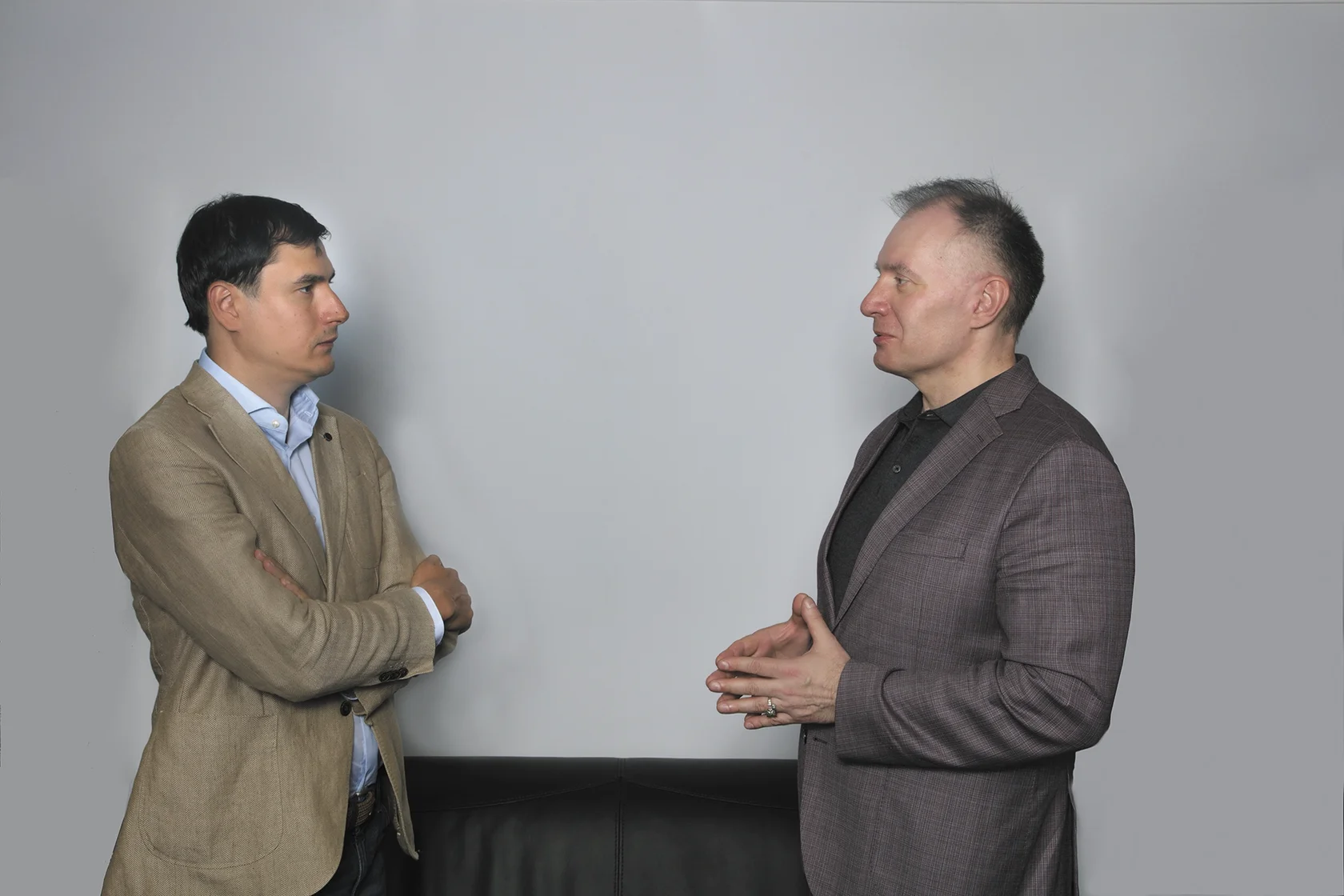
Makushok: Last time we had a fantastic conversation about Gumilyov's poem "The Lost Tram" — it turned out our literary tastes match up remarkably, Sergei! Today we've gathered again to talk about a great but almost unknown poet.
Shargunov: For this conversation, I've brought along the poet, filmmaker, and literary historian Daniil Dukhovskoy. His surname has a clerical ring to it — Daniil comes from a literary family, and in his own way he's a literary character himself. He appears as a character in Limonov's books, and, incidentally, co-authored two books with Eduard... One of his great-grandfathers was the prototype for the main character of Korolenko's novella "The Blind Musician," and on his father's side, his great-grandfather may well have been the Soviet classic writer Konstantin Fedin.
Dukhovskoy: The Fedin story is just a rumor — there's no solid confirmation. But my great-great-grandfather, a blind man from Nizhny Novgorod named Ivan Dukhovskoy, really was friends with Korolenko and with Gorky; it's a fairly well-known fact that he served as the model for Pyotr Popelsky in "The Blind Musician." None of that is any credit to me — I've looked into the family history, the genealogy, but I don't boast about it.
Sh.: Daniil is remarkable not so much for his ancestors as for his love of literature. What I'd like us to talk about today is a poet of unofficial Moscow — almost forgotten, yet at the same time legendary and something of a cult figure. A man who was close both to Stanislav Kunyaev and to Joseph Brodsky. A man who can confidently be counted among the geniuses. His name is Sergey Chudakov.
Shargunov: For this conversation, I've brought along the poet, filmmaker, and literary historian Daniil Dukhovskoy. His surname has a clerical ring to it — Daniil comes from a literary family, and in his own way he's a literary character himself. He appears as a character in Limonov's books, and, incidentally, co-authored two books with Eduard... One of his great-grandfathers was the prototype for the main character of Korolenko's novella "The Blind Musician," and on his father's side, his great-grandfather may well have been the Soviet classic writer Konstantin Fedin.
Dukhovskoy: The Fedin story is just a rumor — there's no solid confirmation. But my great-great-grandfather, a blind man from Nizhny Novgorod named Ivan Dukhovskoy, really was friends with Korolenko and with Gorky; it's a fairly well-known fact that he served as the model for Pyotr Popelsky in "The Blind Musician." None of that is any credit to me — I've looked into the family history, the genealogy, but I don't boast about it.
Sh.: Daniil is remarkable not so much for his ancestors as for his love of literature. What I'd like us to talk about today is a poet of unofficial Moscow — almost forgotten, yet at the same time legendary and something of a cult figure. A man who was close both to Stanislav Kunyaev and to Joseph Brodsky. A man who can confidently be counted among the geniuses. His name is Sergey Chudakov.
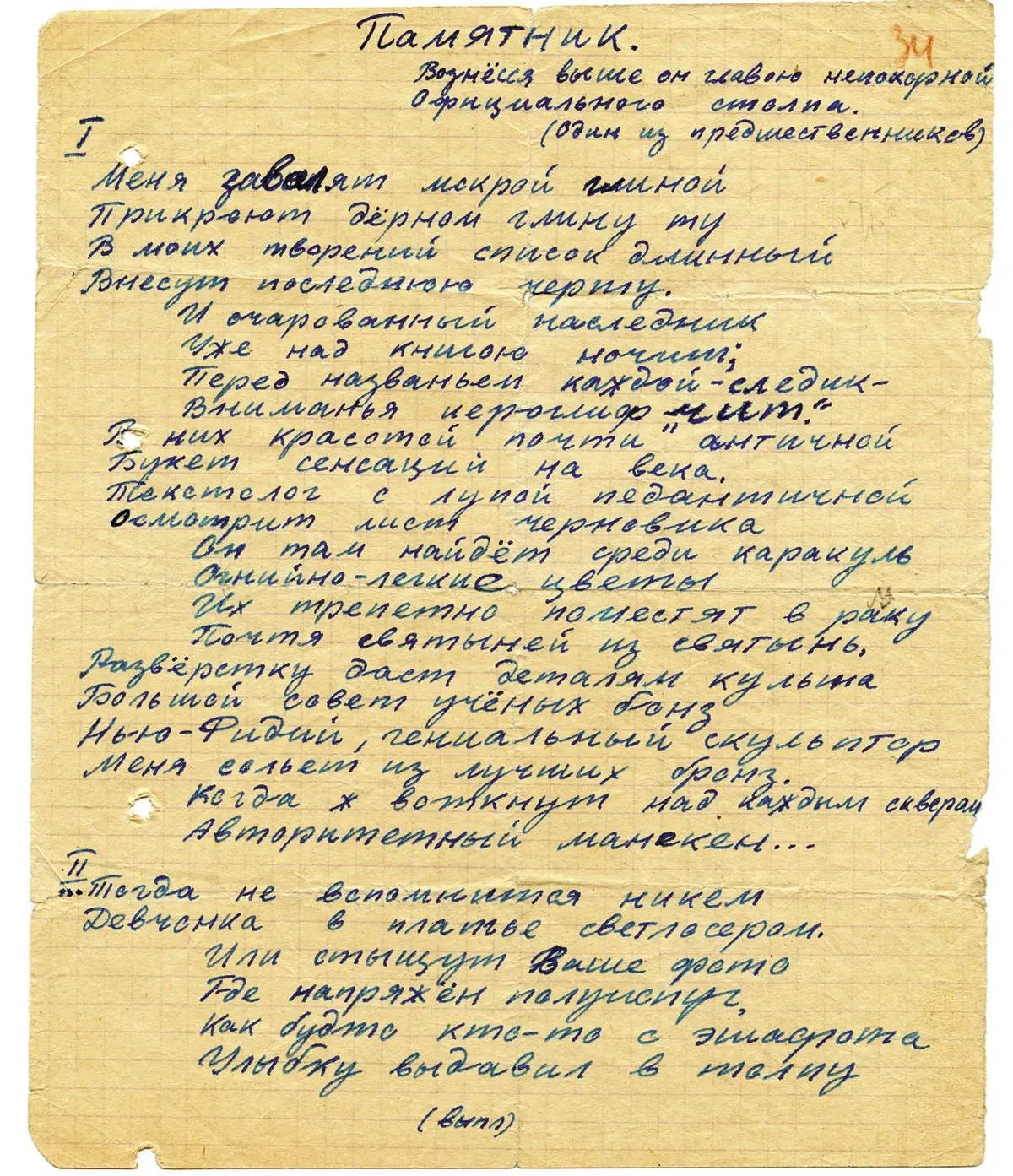
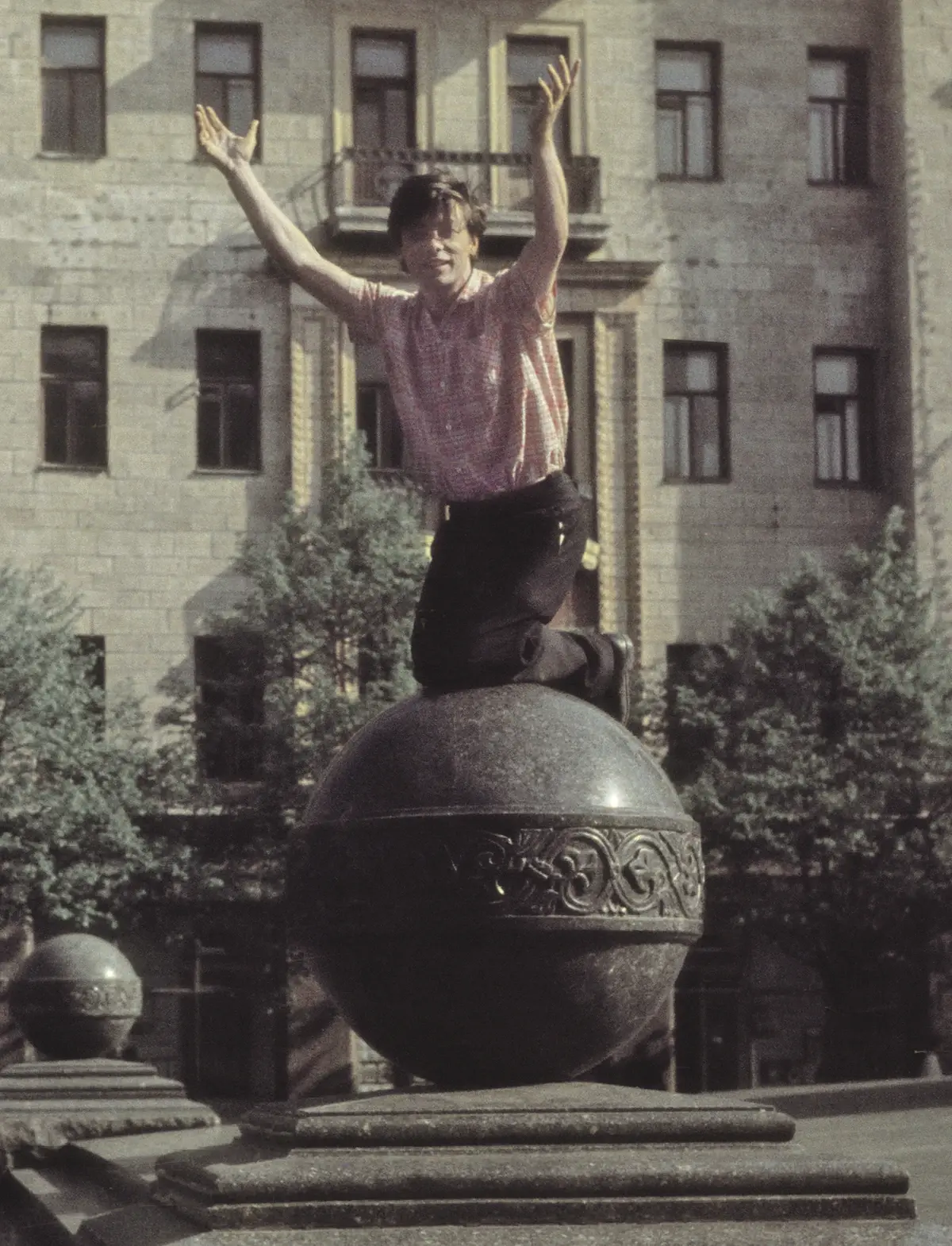
D.: His life story is made up of myths. When I was investigating Chudakov's life, I managed to dispel some of those myths, but strangely enough, despite the facts, the myths turn out to be more resilient and more powerful. So the legend has it that Chudakov was born in 1937 in a labor camp in Kolyma. That's supposed to explain the tragic fracture in his personality. According to the legend, his father was a hard-nosed camp commandant, and his mother was either a prisoner or a civilian employee. In reality, it was like that, but not quite. Chudakov was indeed born in 1937, but not in a camp — in Moscow, in an apartment on Mozhaiskoye Highway, a perfectly comfortable address. His father, Ivan Sevastyanovich, worked for the NKVD; his mother was a housewife. He was posted to the Far East just before the war and became a camp commandant there, but his wife and little Seryozha were living in Moscow at the time. Only once the war began did they evacuate "to the father's place of service." And for a full eight years as a boy, Chudakov did live around camps and mining sites — that part is true. He saw all sorts of things there, but it's hard to tell where the truth ends and the legends he invented himself begin. He loved to shock people with the story that a boy his own age had been kidnapped by prisoners during a hungry wartime winter, drowned, and his body kept in an ice hole, with the prisoners slowly eating his flesh like frozen raw fish. That kind of story made quite an impression on the Moscow intelligentsia. He was a child prodigy, astonishing his peers and teachers from an early age with the colossal amount of knowledge packed into his blond head. Yevgeny Sidorov, the former minister of culture, recalled taking his entrance exams alongside Sergei Chudakov at Moscow State University: 'The whole examination board froze. Seryozha sang — sang like Orpheus, he charmed and mesmerized everyone.' He got into the journalism faculty at Moscow State University with ease, and got kicked out just as easily, after his second year. Various reasons are given for his expulsion, including the claim that, as the group's trade-union organizer, Chudakov proposed at a meeting expelling from the university the reactionary professors the students disliked. The student body — and Sergei Ivanovich in particular — overestimated just how much freedom the 20th Party Congress had actually allowed. And since he was the one most intoxicated by that freedom, they decided to make an example of him. The expulsion order, dated November 29, 1956, reads: '...for systematic disruptive activity within the class, for poor behavior during lectures and seminars, to expel from the ranks of students <...> Chudakov, S.I.' He was thrown out of the journalism faculty, but had no trouble at all beating a path to Moscow's editorial offices. He turned up here, there, and everywhere — at Komsomolskaya Pravda and Voprosy Literatury, at Znamya and Yunost. Most often, though, Chudakov was published in Moskovsky Komsomolets. He showed great promise: a lively style, an easy pen. He made contact with people, with celebrities, without the slightest effort. But just as he'd been thrown out of the university, he was thrown out of the profession too. Certain quirks of his personality made it impossible for him to work effectively. In the written explanation he was forced to submit over a botched work trip and the travel funds he'd spent, he wrote, without batting an eye, that he had 'arrived at the station on time but couldn't bring himself to get on the train.'
Hardly anyone knew that he wrote poetry.
Hardly anyone knew that he wrote poetry.
Among the few who recognized him as a poet as early as the 1960s was, surprisingly, Joseph Brodsky. They met in Moscow, when Brodsky was visiting from Leningrad. We managed to track down witnesses to that meeting. Two young poets, two great beasts of poetry, sniffed each other out, took each other's measure, and formed a mutual respect and affection that lasted a lifetime. Chudakov knew many of Brodsky's poems by heart, and Brodsky remembered Chudakov's. They also saw each other in Leningrad. The poet Pyotr Vegin recalls in his memoirs running into Chudakov and Brodsky once in Moscow, "near Chekhov's little house" — the two were out walking and "practicing short, noun-only lines, preferably of two words." Chudakov came up with: "Moscow. High-rise." Brodsky: "The Fatherland. The Admiralty."
Like any proper hero of myth, Chudakov died several times. In 1972, a rumor went around Moscow that he had died — frozen to death in a stairwell. Chudakov himself started that rumor: he'd sinned rather badly with a certain lady and needed to disappear, to "lie low." He was helped by a friend, the screenwriter Oleg Osetinsky, a vivid, strange, and rather frightening man in his own right. I knew him well. The rumor of Chudakov freezing to death in a stairwell quickly crossed the ocean and reached Brodsky, who had only just emigrated. Brodsky responded to the news with a poem that is now considered one of his most famous — "On the Death of a Friend":
Translation of the Brodsky poem is not provided at this stage, per the editors' request.
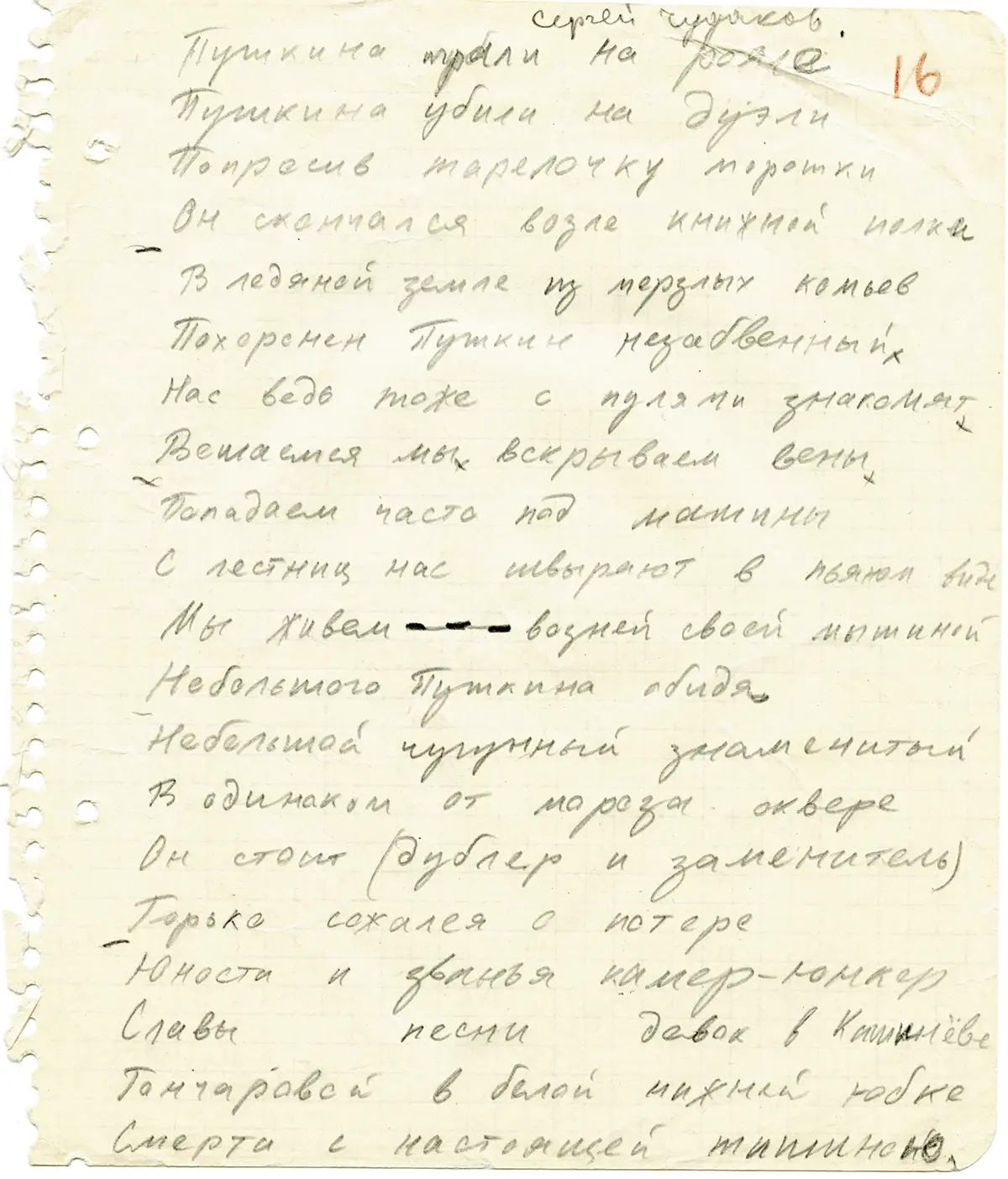
For Chudakov's legacy, this poem plays the same role that Dostoevsky's Pushkin speech did — the speech that, in effect, certified Pushkin as a national genius. Brodsky certified Chudakov as a major poet; he calls him, again with a nod to Pushkin, "the author of the finest of odes on A.S.'s fall into lace and at Goncharova's feet." Chudakov had an early poem that began with the line "They played Pushkin on the piano, they killed Pushkin in a duel..."
Osetinsky used to tell how, in 1990, having ended up in Rome, he ran into Brodsky near the Pantheon, got to talking with him, and within about fifteen minutes the conversation slid around to Chudakov. Brodsky asked how he was doing, whether he was even still alive, and at some point came out with the line that "by the strictest, most honest reckoning, the Nobel should have gone to Seryozha, not to me." What higher endorsement could you possibly ask for?
Like any proper hero of myth, Chudakov died several times. In 1972, a rumor went around Moscow that he had died — frozen to death in a stairwell. Chudakov himself started that rumor: he'd sinned rather badly with a certain lady and needed to disappear, to "lie low." He was helped by a friend, the screenwriter Oleg Osetinsky, a vivid, strange, and rather frightening man in his own right. I knew him well. The rumor of Chudakov freezing to death in a stairwell quickly crossed the ocean and reached Brodsky, who had only just emigrated. Brodsky responded to the news with a poem that is now considered one of his most famous — "On the Death of a Friend":
Translation of the Brodsky poem is not provided at this stage, per the editors' request.
For Chudakov's legacy, this poem plays the same role that Dostoevsky's Pushkin speech did — the speech that, in effect, certified Pushkin as a national genius. Brodsky certified Chudakov as a major poet; he calls him, again with a nod to Pushkin, "the author of the finest of odes on A.S.'s fall into lace and at Goncharova's feet." Chudakov had an early poem that began with the line "They played Pushkin on the piano, they killed Pushkin in a duel..."
Osetinsky used to tell how, in 1990, having ended up in Rome, he ran into Brodsky near the Pantheon, got to talking with him, and within about fifteen minutes the conversation slid around to Chudakov. Brodsky asked how he was doing, whether he was even still alive, and at some point came out with the line that "by the strictest, most honest reckoning, the Nobel should have gone to Seryozha, not to me." What higher endorsement could you possibly ask for?
Sh.: Chudakov got wind of that conversation and demanded his cut of the Nobel money. And through whom, of all people — through Stanislav Kunyaev, editor of the patriotic journal Nash Sovremennik, seemingly Brodsky's polar opposite...
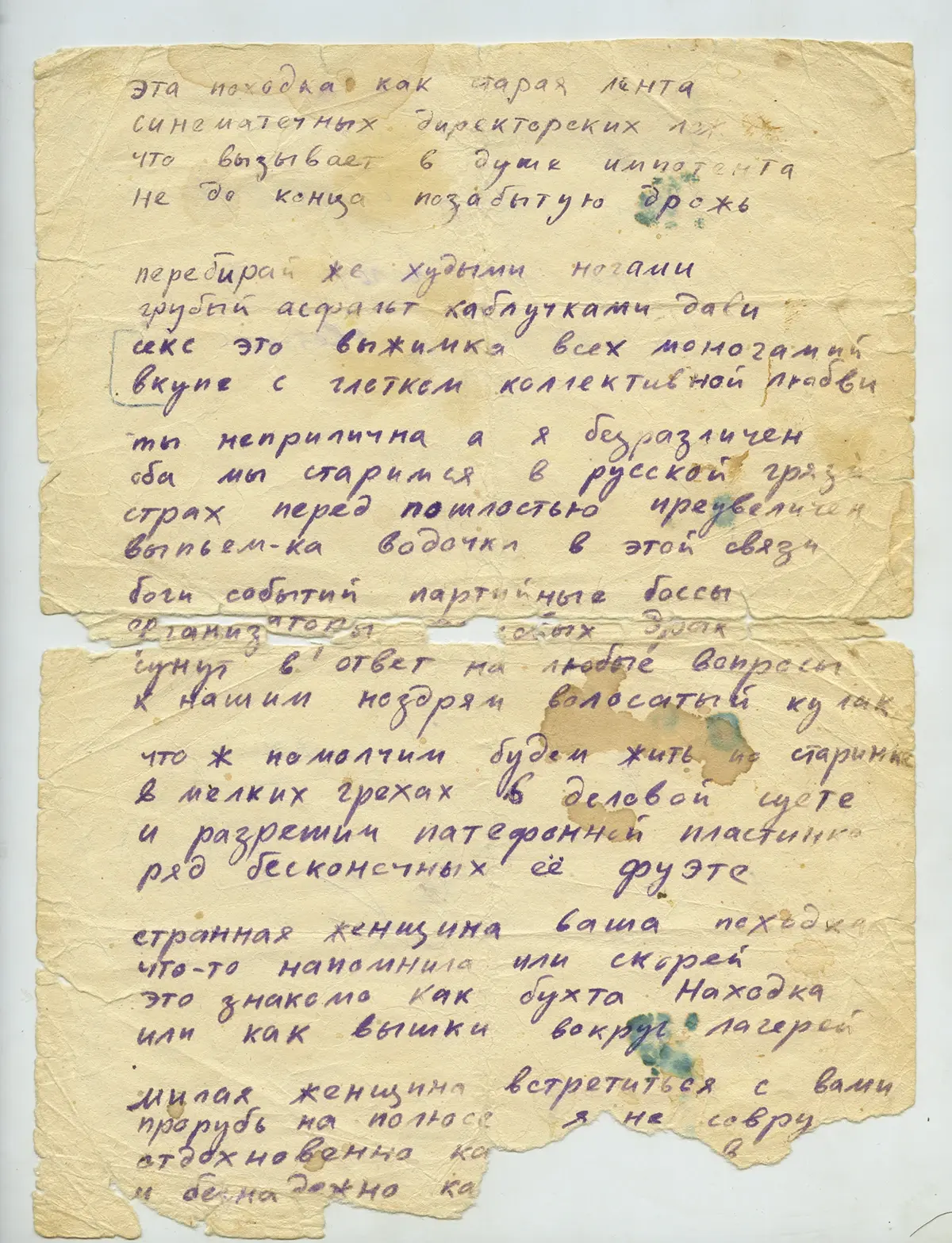
D.: Yes, that's right. By that point Chudakov was already a different man — he had several stretches in prison behind him. What for? Petty crime and procuring. Sometimes he'd steal a briefcase with a lone bottle of vodka inside; sometimes he'd freelance as a pimp; sometimes he'd cause senseless trouble. He was also notorious for stealing books — from friends, from shops, even from the Lenin Library. Some kind of psychological disorder, presumably. Though there's also a view that a certain degree of madness is essential to creativity. Who knows... Chudakov kept getting caught in the gears of the penal system, which, once it's sunk its teeth into a person, keeps sucking them back in and grinding away. He bore up under all of it reasonably well, all things considered. From psychiatric hospitals, he sent letters to a great many acquaintances, many of whom no longer wanted anything to do with him. Stanislav Kunyaev received one such letter. Chudakov was asking for money and books, and — most importantly — had enclosed a letter addressed to Brodsky. In it, he really did demand that the Nobel laureate share some of his prize money with him. Kunyaev, a decent and humane man, found some way of getting Chudakov's letter to Brodsky. And soon got a reply from across the ocean: Brodsky said he'd sent Chudakov some money. Reaching Brodsky through Kunyaev is a strange way to go about it — but that's Chudakov all over.
D.: Yes, that's right. By that point Chudakov was already a different man — he had several stretches in prison behind him. What for? Petty crime and procuring. Sometimes he'd steal a briefcase with a lone bottle of vodka inside; sometimes he'd freelance as a pimp; sometimes he'd cause senseless trouble. He was also notorious for stealing books — from friends, from shops, even from the Lenin Library. Some kind of psychological disorder, presumably. Though there's also a view that a certain degree of madness is essential to creativity. Who knows... Chudakov kept getting caught in the gears of the penal system, which, once it's sunk its teeth into a person, keeps sucking them back in and grinding away. He bore up under all of it reasonably well, all things considered. From psychiatric hospitals, he sent letters to a great many acquaintances, many of whom no longer wanted anything to do with him. Stanislav Kunyaev received one such letter. Chudakov was asking for money and books, and — most importantly — had enclosed a letter addressed to Brodsky. In it, he really did demand that the Nobel laureate share some of his prize money with him. Kunyaev, a decent and humane man, found some way of getting Chudakov's letter to Brodsky. And soon got a reply from across the ocean: Brodsky said he'd sent Chudakov some money. Reaching Brodsky through Kunyaev is a strange way to go about it — but that's Chudakov all over.
M.: How was Chudakov connected to the world of film?
D.: In the most direct way possible. Even back when he was a journalist, he wrote a great deal about film — interviews with Vytautas Žalakevičius, critical pieces on films released in Soviet theaters. In 1962 — two years before shooting even began! — he published a piece in the Leningrad newspaper Smena about Tarkovsky's forthcoming film "Andrei Rublev." Tarkovsky liked the piece and called Chudakov the country's leading film critic. According to Tarkovsky's plan, the role of the bell-founder Boriska in "Andrei Rublev" was meant to go to Chudakov. I have a hypothesis — my own discovery — that Tarkovsky had an idea of casting unofficial poets and writers in the film: he screen-tested Vysotsky and the underground prose writer Yevgeny Kharitonov for various roles (both of them were also professional actors, incidentally), along with the poets Nikolai Glazkov, Sergei Chudakov, and Valentin Khromov. That was the concept. Tarkovsky was himself the son of a major poet, after all, so it makes sense that he had a living connection to literature. For various reasons, the concept couldn't be carried through — the only one who made it into "Rublev" was Nikolai Glazkov, in the role of Yefim the "flying man." Chudakov was desperate to be in the film, was certain he'd play Boriska, and hoped the role would change something important in his fate. He passed his photo and screen tests successfully and was cast. But by then, eighteen-year-old Nikolai Burlyaev had become hopelessly obsessed with the image of Boriska — Tarkovsky had originally called him in for an entirely different role. And Burlyaev got his way: Chudakov, already cast, was dropped from the role, and Boriska went to Burlyaev instead. Nikolai Petrovich played it beautifully. How Chudakov would have played it, we can only guess. Losing that role, he took as an outright catastrophe in his life.
M.: Did the poets of the Sixties generation — Yevtushenko, Voznesensky — know him?
D.: Of course. People recall how Chudakov, by then a man who'd done time and gone to seed, would show up at Yevtushenko's poetry evenings. The hall doors open, and a disheveled, homeless-looking Chudakov calls out from the threshold, 'Zhenya!' — and Yevtushenko answers from the stage: 'Yes, Seryozha, I see you, come on up!' Yevtushenko wrote about Chudakov with real feeling in his anthology 'Strofy Veka' ('Stanzas of the Century'), saying that we had let a major Russian poet slip through our fingers. He was also well acquainted with Andrei Voznesensky.
Sh.: One of his main problems with the law was that he was involved in procuring — bordering on outright pimping. A free-spirited artist adored by women, surrounded by the finest women — and trading in them...
D.: Chudakov undoubtedly had an elevated libido, and what excited him most of all was the process itself of winning over and seducing women. Many he simply talked into submission, burying the poor woman under a torrent of words, phrases, pronouncements. At some point he realized this talent could also be put to profitable use, and started hunting down unsuccessful applicants to the humanities departments of Moscow's universities, promising them connections in artistic circles — and offering his many acquaintances in those same circles the decidedly affordable favors of these naive young women. But his obsessive business drive in this line of work went hand in hand with total impracticality. He'd spend or lose the money almost at once, or have it taken off him. Once, when Lev Prygunov asked him where all the money from his procuring had gone, he answered artlessly: 'Lyova, it all went on overhead...' He successfully married off many of his friends to young women from the provinces. Arranging other people's fates always gave him pleasure. Oleg Osetinsky used to call him 'the matchmaker.'
Sh.: Chudakov also had dealings with my own family. He used to come to the Writers' House on Lavrushinsky Lane. My grandmother, the writer Valeria Gerasimova, knew him; my mother saw Chudakov and remembered him as an extravagant figure. Her friend Olya Golodnaya, daughter of the poet Mikhail Golodny, became Chudakov's beloved — he was her first love.
D.: For Chudakov, his relationship with Olga was the one real love of his life. She and I spoke at length in 2013, and she didn't say a single bad word about Sergei.
M.: But who ended up being the first to publish him? Who took the greatest interest in his fate?
D.: The writer Oleg Mikhailov collected scraps of paper with Chudakov's poems on them — he kept a separate folder, understanding their value. But one day Chudakov turned up at his dacha and either talked him out of that folder or simply stole it. And, of course, promptly lost it. But Mikhailov had a phenomenal memory; he used to say he 'knew Chudakov by heart as well as he knew Pushkin,' and that let him publish a selection of Sergei's poems in Nash Sovremennik in 1992. Chudakov saw it and was pleased.
Sh.: Why is Chudakov a significant voice in Russian poetry?
D.: First of all, there's his skill in versification, which is obvious at first glance and isn't in dispute. Why is he interesting in particular, when there are plenty of good poets around? Because of his view of the world, utterly out of step with the rapturous era he lived in. Unlike most of his contemporaries, he had not the slightest illusion about how life was actually organized. It's an unsparing worldview, directed first and foremost at himself — sober, yet, oddly enough, not without a certain romanticism. His romanticism is the grotesque kind, the romanticism of the doomed. Then there's his gift for the aphoristic — for me, that's one of the hallmarks of major poetry. Chudakov has plenty of finely chiseled lines like these:
Translation of these lines is not provided at this stage, per the editors' request.
Sh.: Yes, and that's precisely why we can say, without hesitation, that he was a major poet. He died in the '90s. Do we know how?
D.: In the most direct way possible. Even back when he was a journalist, he wrote a great deal about film — interviews with Vytautas Žalakevičius, critical pieces on films released in Soviet theaters. In 1962 — two years before shooting even began! — he published a piece in the Leningrad newspaper Smena about Tarkovsky's forthcoming film "Andrei Rublev." Tarkovsky liked the piece and called Chudakov the country's leading film critic. According to Tarkovsky's plan, the role of the bell-founder Boriska in "Andrei Rublev" was meant to go to Chudakov. I have a hypothesis — my own discovery — that Tarkovsky had an idea of casting unofficial poets and writers in the film: he screen-tested Vysotsky and the underground prose writer Yevgeny Kharitonov for various roles (both of them were also professional actors, incidentally), along with the poets Nikolai Glazkov, Sergei Chudakov, and Valentin Khromov. That was the concept. Tarkovsky was himself the son of a major poet, after all, so it makes sense that he had a living connection to literature. For various reasons, the concept couldn't be carried through — the only one who made it into "Rublev" was Nikolai Glazkov, in the role of Yefim the "flying man." Chudakov was desperate to be in the film, was certain he'd play Boriska, and hoped the role would change something important in his fate. He passed his photo and screen tests successfully and was cast. But by then, eighteen-year-old Nikolai Burlyaev had become hopelessly obsessed with the image of Boriska — Tarkovsky had originally called him in for an entirely different role. And Burlyaev got his way: Chudakov, already cast, was dropped from the role, and Boriska went to Burlyaev instead. Nikolai Petrovich played it beautifully. How Chudakov would have played it, we can only guess. Losing that role, he took as an outright catastrophe in his life.
M.: Did the poets of the Sixties generation — Yevtushenko, Voznesensky — know him?
D.: Of course. People recall how Chudakov, by then a man who'd done time and gone to seed, would show up at Yevtushenko's poetry evenings. The hall doors open, and a disheveled, homeless-looking Chudakov calls out from the threshold, 'Zhenya!' — and Yevtushenko answers from the stage: 'Yes, Seryozha, I see you, come on up!' Yevtushenko wrote about Chudakov with real feeling in his anthology 'Strofy Veka' ('Stanzas of the Century'), saying that we had let a major Russian poet slip through our fingers. He was also well acquainted with Andrei Voznesensky.
Sh.: One of his main problems with the law was that he was involved in procuring — bordering on outright pimping. A free-spirited artist adored by women, surrounded by the finest women — and trading in them...
D.: Chudakov undoubtedly had an elevated libido, and what excited him most of all was the process itself of winning over and seducing women. Many he simply talked into submission, burying the poor woman under a torrent of words, phrases, pronouncements. At some point he realized this talent could also be put to profitable use, and started hunting down unsuccessful applicants to the humanities departments of Moscow's universities, promising them connections in artistic circles — and offering his many acquaintances in those same circles the decidedly affordable favors of these naive young women. But his obsessive business drive in this line of work went hand in hand with total impracticality. He'd spend or lose the money almost at once, or have it taken off him. Once, when Lev Prygunov asked him where all the money from his procuring had gone, he answered artlessly: 'Lyova, it all went on overhead...' He successfully married off many of his friends to young women from the provinces. Arranging other people's fates always gave him pleasure. Oleg Osetinsky used to call him 'the matchmaker.'
Sh.: Chudakov also had dealings with my own family. He used to come to the Writers' House on Lavrushinsky Lane. My grandmother, the writer Valeria Gerasimova, knew him; my mother saw Chudakov and remembered him as an extravagant figure. Her friend Olya Golodnaya, daughter of the poet Mikhail Golodny, became Chudakov's beloved — he was her first love.
D.: For Chudakov, his relationship with Olga was the one real love of his life. She and I spoke at length in 2013, and she didn't say a single bad word about Sergei.
M.: But who ended up being the first to publish him? Who took the greatest interest in his fate?
D.: The writer Oleg Mikhailov collected scraps of paper with Chudakov's poems on them — he kept a separate folder, understanding their value. But one day Chudakov turned up at his dacha and either talked him out of that folder or simply stole it. And, of course, promptly lost it. But Mikhailov had a phenomenal memory; he used to say he 'knew Chudakov by heart as well as he knew Pushkin,' and that let him publish a selection of Sergei's poems in Nash Sovremennik in 1992. Chudakov saw it and was pleased.
Sh.: Why is Chudakov a significant voice in Russian poetry?
D.: First of all, there's his skill in versification, which is obvious at first glance and isn't in dispute. Why is he interesting in particular, when there are plenty of good poets around? Because of his view of the world, utterly out of step with the rapturous era he lived in. Unlike most of his contemporaries, he had not the slightest illusion about how life was actually organized. It's an unsparing worldview, directed first and foremost at himself — sober, yet, oddly enough, not without a certain romanticism. His romanticism is the grotesque kind, the romanticism of the doomed. Then there's his gift for the aphoristic — for me, that's one of the hallmarks of major poetry. Chudakov has plenty of finely chiseled lines like these:
Translation of these lines is not provided at this stage, per the editors' request.
Sh.: Yes, and that's precisely why we can say, without hesitation, that he was a major poet. He died in the '90s. Do we know how?
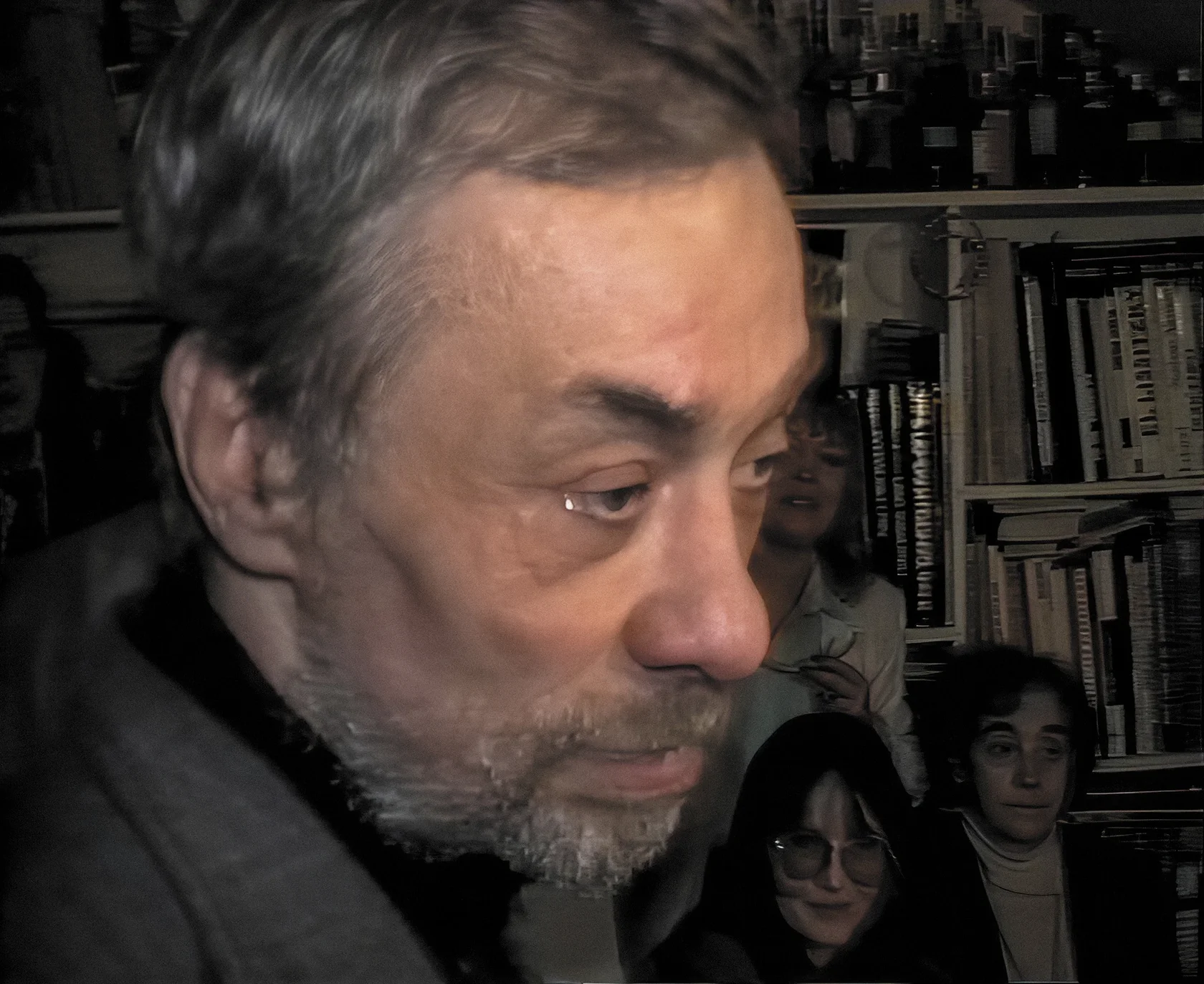
D.: His end was a complete mystery. As late as 2012, no one knew for certain whether he was dead or alive. Oleg Osetinsky spread a rumor that Chudakov had been murdered by people from the Caucasus over his apartment on Kutuzovsky Prospekt. Plenty of people believed it. Once, my colleague, the actor Lev Prygunov, and I went to Chudakov's building together. An old woman in her nineties came out and genuinely began to wail: 'He's alive, he's alive! They locked him up in the madhouse, and they're the ones paying for the apartment now...' In the end, the truth did come out. He really did die on the street — either of a heart attack or from exposure — in late October 1997. The 1972 prophecy had finally come true. Recently someone forwarded me the police's post-mortem photographs: streaks of blood on his face, bruising, a broken nose. It looks more like he was beaten and left to die. His body was found in an archway of a building on Kutuzovsky Prospekt, not far from where he lived — with no documents on him. It was taken to the morgue as unidentified. Once the required period had passed, it was cremated and buried in a grave for unclaimed remains. Then, six months later, a response came back from the Interior Ministry's fingerprint center: the prints belonged to one Sergei Ivanovich Chudakov, a man with multiple prior convictions...
Sh.: A man in love with the word, obsessed with the word. I think it was precisely this sense that the word comes first that made him at once so inventive, so gifted — and so hopelessly unlucky in life. Because the word was the spirit that carried him. And it really matters, honestly, to remember national geniuses like this. I'd like you to read one of Chudakov's poems.
The Anthill
The nonsense that we call the world
Handmade deliriun and dream
By Willie Shakespeare the entomologist
Was raised above the ground for an arshin
I love the theatrical folds
of all your chitinous masks
Rubbing paws against paws
The bustle before laying eggs
Rustling in a quite chorus
In the mignight of broad daylight
With a labyrinth of its corridors
The anthill is pulling me
We'll put the atoms to microcrystals
We move the clumps of the earth
So you're sending the signals to me
On Salvadore Dali's mustache
Raider and vagabond, don't slow down
Make a holiday for the captive soul
With a red-hot forest firewood
Plow the crazy sack
Sh.: A man in love with the word, obsessed with the word. I think it was precisely this sense that the word comes first that made him at once so inventive, so gifted — and so hopelessly unlucky in life. Because the word was the spirit that carried him. And it really matters, honestly, to remember national geniuses like this. I'd like you to read one of Chudakov's poems.
The Anthill
The nonsense that we call the world
Handmade deliriun and dream
By Willie Shakespeare the entomologist
Was raised above the ground for an arshin
I love the theatrical folds
of all your chitinous masks
Rubbing paws against paws
The bustle before laying eggs
Rustling in a quite chorus
In the mignight of broad daylight
With a labyrinth of its corridors
The anthill is pulling me
We'll put the atoms to microcrystals
We move the clumps of the earth
So you're sending the signals to me
On Salvadore Dali's mustache
Raider and vagabond, don't slow down
Make a holiday for the captive soul
With a red-hot forest firewood
Plow the crazy sack